
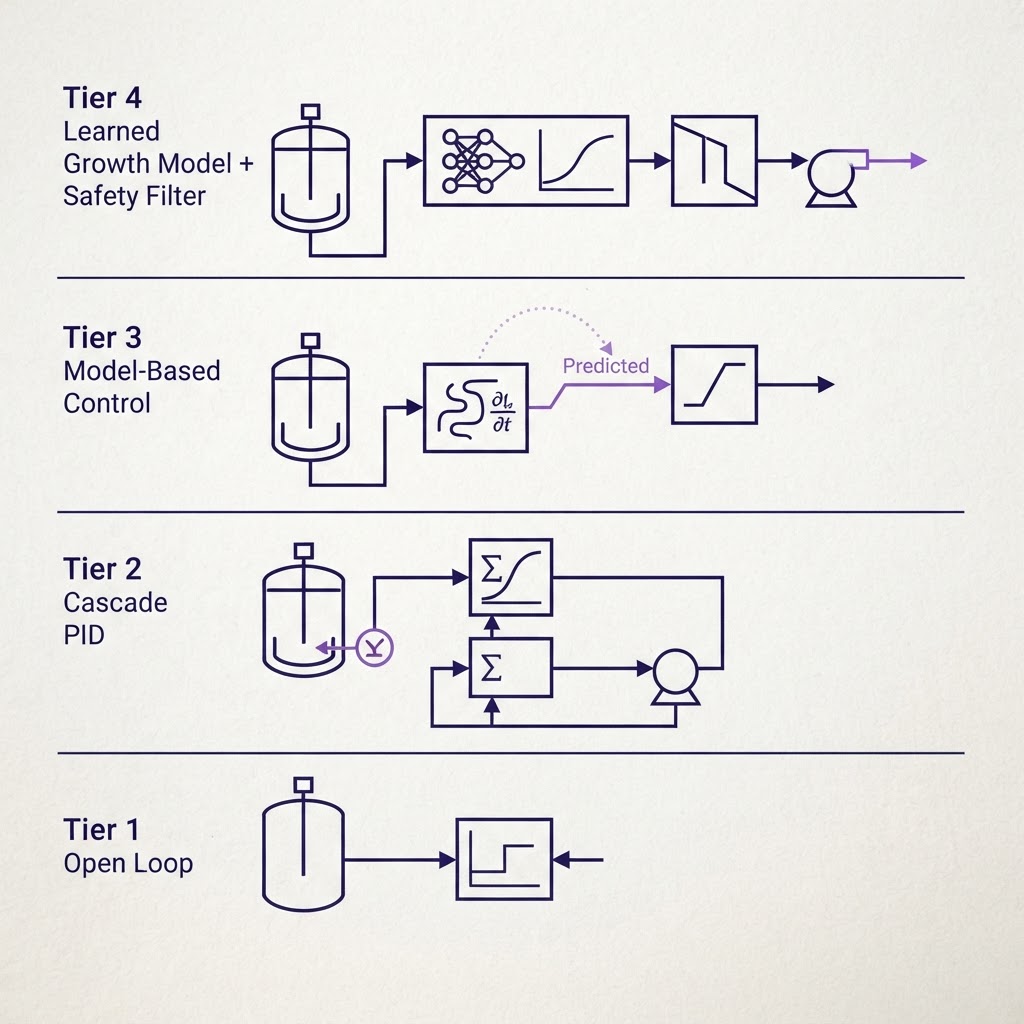
A bioreactor control strategy is the arrangement of measurement, model and actuation that holds a culture inside its operating window, not just the controller sitting at the end of it. The four options in practice are an escalation: open loop, closed loop with cascade, model-based control, and a model that learns the process instead of one that is derived by hand. Each rung exists because the one below it has a specific, documented failure mode. This article walks the escalation in order, then covers what changes when the model in the loop is learned.
Why open loop is still the first strategy on almost every bioreactor
Open loop control applies a predetermined feed or setpoint profile, calculated offline from initial conditions and growth kinetics, without any online measurement correcting it along the way. A review of bioprocess control strategies describes it as the oldest and simplest technique in the field, still employed for carbon-limited fermentation processes at industrial scale. It requires no online sensor and no model that runs in real time, only a precomputed profile.
That is also exactly what it cannot do. The review is direct about the limitation: an open loop strategy is unable to dismiss any disturbance in the system, because the input at any moment depends only on the plan made before the batch started, not on what is actually happening inside the vessel. Researchers have used it deliberately anyway, to reduce batch-to-batch variability on processes where the growth kinetics are well characterized and the risk of an unanticipated disturbance is low. The reason it persists industrially is not that anyone thinks it is best. It is that a sensor, a model and a control loop are each an investment, and open loop is the only strategy that asks for none of them.
Closed loop and cascade: what a second measurement buys you
The first escalation is closing the loop: measure a variable online and feed it back into the controller, typically through PID. The second escalation is cascade: add a second, faster inner loop around a variable that reacts sooner than the one you actually care about.
The mechanism is concrete on a real industrial fermentation. Work on oxygen control for a pilot-scale fed-batch filamentous fungal process reports that standard PID control of dissolved oxygen holds the setpoint at 25 plus or minus 10, a wide enough band that the operator either accepts frequent oxygen limitation or feeds conservatively and loses production. Adding a cascade structure, where an outer loop sets a target for the oxygen uptake rate and an inner loop tracks it, tightens that same process to 25 plus or minus 2. The secondary loop absorbs the fast disturbance before it ever reaches the primary variable, which is the whole argument for cascade over a single PID loop: more sensors mean the correction happens closer to where the disturbance enters the system.
Simulation work makes the same point from the failure side. A comparison of control strategies on a yeast ethanol fermentation shows that controlling reactor temperature alone cannot hold the ethanol concentration at its target once a disturbance shifts the biomass growth rate; an offset appears and stays. Adding a cascade loop, where a delayed ethanol measurement sets the temperature setpoint, removes most of that offset. The paper's own conclusion is blunt about when the extra loop is worth it: single-variable control is enough only until a disturbance the single loop cannot see enters the process.
Cascade does not require an accurate mechanistic model to build. An experimental validation of cascade control on continuously perfused HEK-293 cell cultures, run over 26 days on real cultures rather than in simulation, uses sliding-mode observers in the inner loop specifically because they do not require prior process knowledge, paired with simple PI controllers with autotuning in the outer loop. That is the practical appeal of cascade as a strategy: it buys a real improvement in disturbance rejection without first paying for a model of the biology.
Model-based control: closing the loop on a model instead of a measurement
Model-based control is a different kind of escalation. Instead of reacting to what a sensor reports after the fact, the controller simulates the process forward and acts on the predicted trajectory, correcting the plan before the disturbance has fully arrived.
The clearest industrial demonstration of what that buys is a 550 L filamentous fungal fed-batch study run at Novozymes. The strategy has two stages: an offline mechanistic model calculates the appropriate starting fill for the batch, then an online model-based controller, recursively updated with live measurements, adjusts the feed rate to hit a target fill while avoiding oxygen limitation. Across 16 pilot-scale runs under four different operating conditions, the strategy hit the fill target within 5 percent, and cut the variance in final batch fill by over 74 percent compared with the reference, manually operated process. That is the case for model-based control stated as plainly as the literature states it anywhere: a mechanistic model, run online, turned an inconsistent batch outcome into a reproducible one.
It is not free of risk just because it is more principled. Work applying model predictive control to a nonlinear, open-loop-unstable penicillin fed-batch fermentation is honest that the nonlinear optimisation at the center of MPC can itself fail on a strongly nonlinear bioreactor: the ODE solver used to simulate the process forward broke down, and the optimisation problem became severely ill-conditioned, before the authors substituted a piecewise-linear approximation of the model to make the online computation tractable. Model-based control shifts the risk from the plant to the model. If the model is wrong, or too expensive to run at the required speed, the controller inherits that problem directly.
Hybrid and predictive layers: what a 2026 result adds
The most recent published result in this space combines two of the strategies above rather than choosing between them. A 2026 study on beer fermentation control uses fuzzy logic control as the base layer, holding fermentation temperature to plus or minus 0.3 degrees Celsius and pH to plus or minus 0.05, then adds a model predictive control layer on top. The MPC layer improves substrate conversion efficiency by 8.5 percent and cuts total fermentation time by roughly 12 hours, compared with the fuzzy-only baseline.
The pattern is the same one that justified cascade over single-loop PID: the fuzzy layer holds the process steady but cannot plan ahead for a coming disturbance or optimise the batch trajectory as a whole, and the predictive layer is added specifically to answer that limitation. Whether the 12 hours and 8.5 percent are worth the engineering cost of building and validating an MPC layer depends entirely on the value of the product and the size of the reactor. Nothing in the paper, or in the rest of the literature reviewed here, makes that trade-off for you.
When the model in the loop is learned rather than mechanistic
Every model-based strategy above depends on a mechanistic model derived by hand for that specific process: written down, fitted to data, and revalidated whenever the process changes. The alternative is to fit a model directly to process data instead of deriving it, which is what continuous-time model fitting for nonlinear systems is built for. A learned growth model can capture dynamics that would be expensive to derive from first principles, at the cost of needing a validation record instead of a physical derivation to justify trusting it.
What does not change is the structure underneath it. A learned model still sits inside the same cascade and regulatory layers described above; it does not replace the fast secondary loop that absorbs a disturbance before it reaches the culture. And because a learned model is a statistical fit rather than a physical law, it needs something the mechanistic controllers above did not: a safety layer that can veto its output before an unsafe action reaches an actuator, which is the role a barrier-function safety filter plays on a cultivation basin specifically.
What this looked like on a 500 L pilot basin
Our own control stack, described on equation-labs.co, is a live version of the learned-model rung of this escalation. The growth model reaches an accuracy of R-squared above 0.95. The safety layer, sitting in front of the learned policy exactly as described above, answers in under 2 milliseconds. End-to-end edge latency, from sensor reading to actuator command, is 285 milliseconds, reduced from an earlier 1.2 seconds. Before the controller acted on a live culture at all, it was run through sim-to-real validation across 400 simulated years on a 500 L pilot basin, with zero recorded safety violations.
Read the simulated years as what they are: coverage of the state space the controller might encounter, not 400 years of elapsed operating time. That distinction matters more here than it would on a robot, because a bioreactor cannot be reset the way a robot can. A crashed culture restarts on the same timescale as the growth it interrupted, which is exactly why the validation happens in simulation, exhaustively, before the model is trusted on anything alive. A system built around one of these strategies is a separate, narrower question from which strategy to pick, and worth treating on its own.
Choosing a strategy for your own reactor
The literature above does not converge on one best strategy, because there is not one. It converges on an order in which to consider them, each rung justified by a specific failure of the one before it.
Stay open loop only if the process is carbon-limited, well characterized, and disturbances are rare enough that a precomputed profile covers most batches. Add a cascade secondary loop the first time a single measurement cannot reject a disturbance you can actually observe, as it could not on the yeast temperature-only case above, and target the loop at whichever variable reacts fastest to that disturbance, as the oxygen-uptake-rate cascade did. Move to model-based control only once a model, mechanistic or learned, exists that is accurate enough to act on; a wrong model driving the process is worse than no model at all, which is the real lesson of the penicillin MPC paper's ODE solver failures. And add a hybrid predictive layer on top of an already-working controller only when the measured gain, in yield, batch time, or product value, is large enough to justify the engineering and validation cost of building it, the same trade the 2026 brewing study left for its reader to make.
FAQ
What is the simplest bioreactor control strategy?
Open loop: a predetermined feed or setpoint profile, calculated offline from initial conditions and growth kinetics, applied without online measurement. It is still used industrially for carbon-limited fermentations because it needs no sensor or model investment, but it cannot reject any disturbance that was not anticipated when the profile was calculated.
Why use cascade control instead of a single PID loop on a bioreactor?
Because a single loop can only react to the variable it measures. On an industrial filamentous fungal fermentation, standard PID held dissolved oxygen at 25 plus or minus 10; adding a cascade secondary loop on the oxygen uptake rate tightened that to 25 plus or minus 2, because the fast disturbance is absorbed in the secondary loop before it reaches the primary one.
When does a bioreactor need model predictive control instead of PID or cascade control?
When the process is nonlinear enough, or the target valuable enough, that predicting the trajectory forward beats reacting to it. A 2026 study found adding MPC on top of an already-tuned fuzzy-logic layer improved substrate conversion efficiency by 8.5 percent and cut fermentation time by 12 hours. The trade-off is real: on a strongly nonlinear process like penicillin fed-batch, the online optimisation itself can fail before it is simplified.
Can a learned model replace a mechanistic model in a bioreactor control loop?
Yes for the growth model itself, no for the layers around it. A learned model still sits inside the same cascade and regulatory structure, and still needs a safety layer that can veto its output, because a learned model is a statistical fit rather than a law of the process.
How is a bioreactor controller validated before it runs on a live culture?
Against a simulated version of the process first, deliberately stressed across a wide range of conditions, because a crashed culture cannot be restarted on the next control cycle the way a robot can be reset. One documented control stack was validated across 400 simulated years on a 500 L pilot basin with zero safety violations before deployment.