
Search for contract research and development services and the entire first page answers a drug developer. The exact-match pages sell hit-to-lead studies and IND-enabling packages across 60 facilities. The market itself is segmented in those terms, where contract research and manufacturing are often separate services and a CRDMO integrates what would otherwise be multiple vendors.
None of that is wrong. It is just one industry that happens to own the phrase commercially. If the thing you want researched is a process, a controller or a model, you need a different page, because contract R&D is a contracting mode rather than an industry. The definitional groundwork, including the five criteria that decide whether the work qualifies as research at all, is covered separately in what contract research and development actually is. This article is about the commercial decision that comes after: what you are buying, what it should cost, and how to tell one provider from another.
What is on the menu when the deliverable is not a molecule
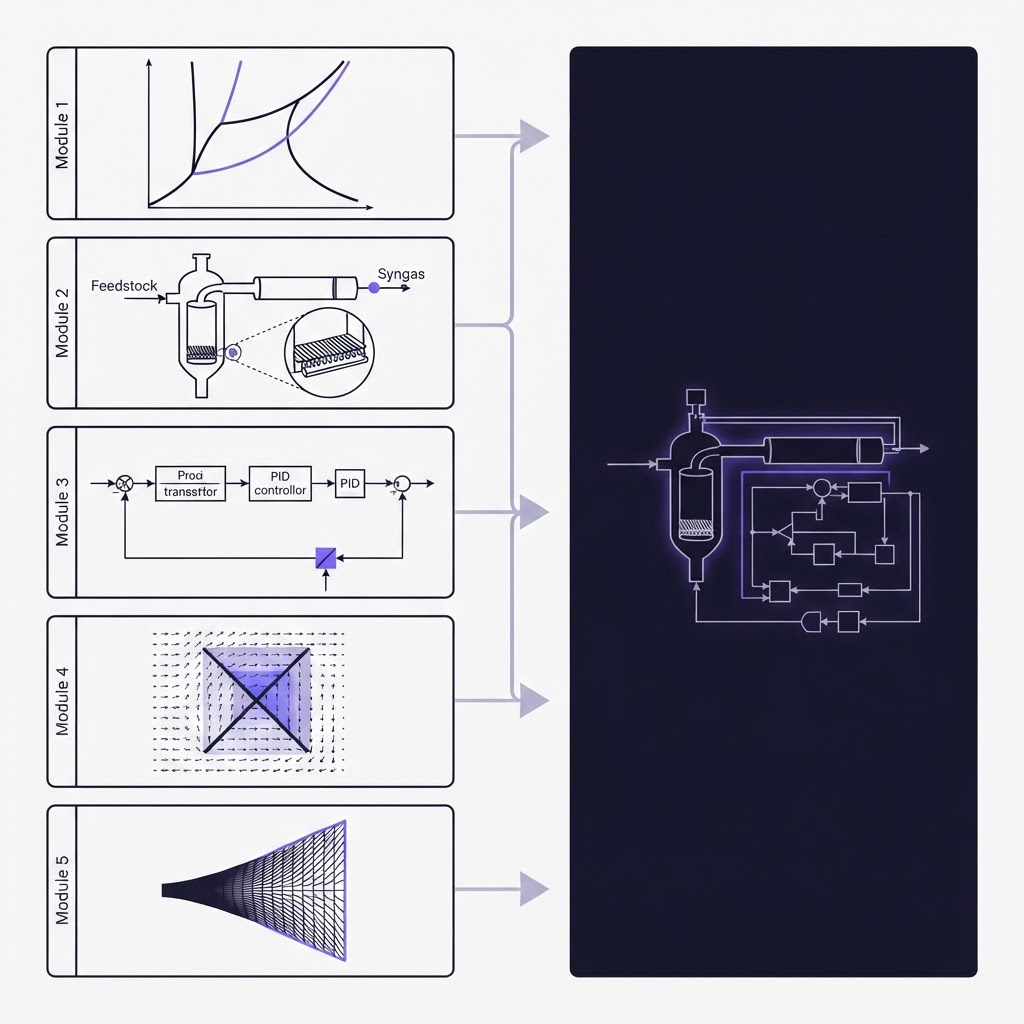
Outside life sciences, a contract research programme in industrial and biological process control usually decomposes into five service lines. They are worth naming because most providers describe capability rather than scope, and the two are not the same thing.
- Continuous-time modelling. Deriving a model of the process itself, rather than fitting a predictor to whatever logs exist. This is where neural differential equations and causal inference sit.
- Control design with a safety argument. Not a policy that performs well in aggregate, but one with a stated envelope it provably will not leave.
- A validation and certification campaign. The evidence that the controller behaves as claimed, produced deliberately rather than assembled afterwards.
- Edge deployment. Compression and hardware targeting so inference runs at the process, within its latency budget, without a cloud round trip.
- The transfer package. Documentation, data and procedures sufficient for someone else to re-run the work.
Our own two delivered programmes, documented at Equation Labs, cut this way. OptiVX ran as work package AP1, Core AI and ML models, as primary R&D partner to Gemino, across 29 accounted work phases, producing a measured +31% yield increase and 400 simulated years certified. IntelliBot ran as work package AP3, Predictive validation, for MindWaves AI Solutions GmbH, across 4 workstreams with 8-node horizontal scaling.
The number to notice is 29. A programme cut into 29 accounted phases can be audited after the fact, by you, by a certification body and by whoever eventually assesses the research tax claim. A programme sold as four months of effort cannot.
The deliverable is the record, not the demo
This is the part the SERP does not tell you, and it is the reason most of this spend disappoints.
The 2026 Industrial AI Readiness Survey found that 68 percent of organisations are still in pilots, proofs of concept or limited deployments, while only 7 percent have AI embedded in core operational processes, and 15 percent explicitly name scaling pilots into production as their primary barrier. Those numbers are usually read as a technology problem. Read them as a contracting problem instead. A contract whose acceptance criterion is a working demonstration is a contract that buys membership of the 68 percent, because a demonstration proves the contractor could do the work and says nothing about whether you can continue without them.
There is a formal version of this test. The Frascati Manual requires that research be transferable or reproducible to count as R&D at all. A programme that cannot be handed over has arguably failed the definition, whatever it demonstrated on the day. That criterion quietly sets the documentation standard for the whole engagement, and it is the one thing you should be hardest about in the scope. IntelliBot closed with 400+ pages of transfer documentation. That is not overhead attached to the deliverable. It is the deliverable.
The practical form of this in a proposal: the validation record and the transfer package appear as named work packages with their own acceptance criteria and their own payment triggers, not as a closing paragraph about knowledge sharing.
Pricing a programme whose outcome is uncertain
Why fixed price mostly does not survive contact with research
Uncertainty of outcome is part of the definition of R&D, which makes a not-to-exceed quote a promise about something nobody knows yet. The honest version of the commercial structure is well described in the engineering literature: few tasks in R&D beyond the first exploratory phases can be confidently quoted in not-to-exceed terms, so subsequent phases are given a cost range based on similar past projects and ultimately require payment on actual time and materials, with 10 to 20 percent buffers negotiated and larger margins for higher-risk programmes. The same source recommends the sequence that keeps that fair: an executive summary and a rough order of magnitude budget from three or four candidates, then formal proposals structured identically from the two or three you shortlist.
The hybrid that works in practice is a fixed-fee discovery phase of four to six weeks followed by time and materials against a budget ceiling with milestone checkpoints, where every milestone carries acceptance criteria and cumulative change orders are capped at 10 to 15 percent of project value. A milestone without acceptance criteria is a calendar date. An uncapped change order process is the mechanism by which research budgets quietly double.
The engagement vocabulary worth borrowing from pharma
The industry that dominates this SERP has one genuinely transferable asset, and it is its language for engagement structure. Clinical research outsourcing distinguishes full-service outsourcing, which is end-to-end and usually contracted on a milestone or unit basis, from functional service provider partnerships, which are allotted by function rather than by study and priced on full-time equivalents, units or time and materials.
Strip the trial vocabulary and the distinction is exactly the one you face. Are you commissioning a research outcome with single-point accountability, or renting a capability into your own programme? The two are priced differently, governed differently and fail differently. Deciding which you actually want before the first call removes most of the ambiguity from every proposal you then read.
One trap to name explicitly. It is misleading to compare quotes to salaries, because your own staff cost also carries pension, premises, equipment, software licences, recruitment, insurance and under-utilisation. A quote that looks expensive against a salary line is usually the fully loaded market rate for the work.
Evaluating a research partner, not a delivery vendor
Most published selection frameworks were written for product and software delivery. The mechanics transfer well. A nine-criterion rubric applied as a scorecard during candidate deep-dives, with a realistic 4 to 8 week timeline across shortlisting, capability deep-dives, reference checks and contracting is sound process, and its process-maturity criterion, meaning phase-gate discipline with named deliverables, requirement traceability and validation discipline, is the single most predictive item on the list for research work too.
Several of its criteria do not transfer. In-house fabrication, design for manufacturability and prototype iteration turnaround presuppose a physical artefact and a specifiable output. Research has neither by definition. Substitute these three, which are specific to buying research:
- Can they show you a validation record from a past programme? Redacted is fine. Its structure tells you more than any case study, because a case study is written by marketing and a validation record is written by whoever will be doing your work.
- Is the phase accounting granular enough to audit? Ask how the last programme was broken down and how progress was accounted against it.
- Who are their institutional counterparties? Research partners and published work are independently verifiable in a way that "experienced team" is not.
Two failure modes deserve naming because they are more expensive in research than in delivery. The first is the A-team and B-team substitution: the experienced people negotiate, a different set executes, and the remedy is seeking assurances about who will actually work on the project, with the partner at minimum able to commit the project leader by name. The second is an incentive conflict. A partner running its own internal projects in your field has a standing reason to keep the best ideas, whatever the IP clause says.
There is also a cheap diagnostic for whether you are talking to a research partner or a supplier. If every discussion revolves around delivery timelines, resource availability and pricing you are probably talking to a vendor; if the conversation shifts to engineering practices, technical risk and your constraints, you are probably talking to a partner. Count the questions they ask about your process before they present anything.
What changes when the controller acts on a live process
Everything above applies to research generally. Three things change when the output of the programme will act on a running physical or biological system, and they are why we do this work the way we do.
Safety stops being a review stage and becomes a component with a latency budget. On our control stack the safety layer runs under 2 ms, because a guarantee that arrives after the actuator has moved is not a guarantee. Deployment stops being an afterthought: end-to-end edge latency of 285 ms, reduced from 1.2 s, is what makes closed-loop control at the plant possible at all, which is why the compression trade-offs in knowledge distillation vs quantization belong in the research scope rather than in a later engineering sprint. And validation stops being a test campaign and becomes a simulation argument: growth-model accuracy above R-squared 0.95 and zero safety violations across 400 simulated years, on a 500 L pilot basin, is the shape of the evidence a certification body will actually accept. The methods behind that sit in sim to real transfer and safe reinforcement learning for industrial process control.
The institutional side matters for the same reason. Our research partners are Monash University, Fraunhofer Institute IKTS, Hochschule Zittau-Goerlitz and Robert Boyle Institut. Ask any prospective partner for the equivalent list, then check it.
Where the contractor is seated changes what the programme costs you
One point, and it surprises people late in a negotiation. Under the German research allowance, 70 percent of the contractor fee is the eligible basis, only the client may claim it, and the contractor must be seated in the European Economic Area, which excludes the USA, China, India and, since Brexit, the UK. A provider outside the EEA can be excellent and still cost a German client materially more after relief.
Equation Labs is registered in Las Palmas de Gran Canaria, Spain, and its research work is eligible under the FZulG. The mechanics of the claim, and the traps in it, are covered in the German research allowance and the 70 percent rule. Raise it during scoping, not in a year-end tax review, because by then the contract is signed.
The shortlist to take into the first meeting
- Am I commissioning an outcome or renting a capability? Decide before the first call.
- Which of the five service lines am I actually buying, and where does the scope stop?
- Is the validation record a named work package with its own acceptance criteria?
- What is in the transfer package, and when is it delivered?
- How was your last programme accounted, phase by phase?
- Who leads this work, by name, and will they still be on it in month six?
- Is discovery fixed-fee, is the rest capped, and where does the change-order ceiling sit?
- Are you seated where my relief regime requires?
FAQ
What is the difference between a CRO and a contract R&D provider?
A CRO is an organisation type defined within life sciences: a provider contracted by a sponsor to carry out trial-related duties, under that industry's regulatory apparatus. Contract R&D is a contracting mode that applies to any discipline, including materials, control systems, process equipment and software. Every CRO performs contract R&D. Most contract R&D providers are not CROs and will not recognise the acronym.
Do contract research and development services include manufacturing?
Not by default, and the pharma market's own segmentation is the clearest illustration: research, development and manufacturing are separate service categories that only a CRDMO combines under one organisation. Outside pharma, the equivalent question is whether the contract ends at a validated model or continues into deployment, integration and support. Answer it in the scope. It is the most common source of a gap between what was delivered and what was expected.
How much do contract research and development services cost?
There is no rate card, because scope and uncertainty differ per programme. There is a sanity check: a quote should approximate the fully loaded market rate for an equivalent internal team, so a figure that looks high against a bare salary usually is not. Expect a rough order of magnitude budget before any formal proposal, and expect the higher-risk phases to carry an explicit contingency.
How long does it take to select a contract R&D partner?
Four to eight weeks from shortlist to signed master agreement is the realistic range for a serious programme: one to two weeks shortlisting, two to three weeks of capability deep-dives, a week of reference checks and one to two weeks contracting. Contracting delays are rarely about price. They are about IP, indemnification and acceptance criteria, which is why those three should be raised in week one rather than week six.