
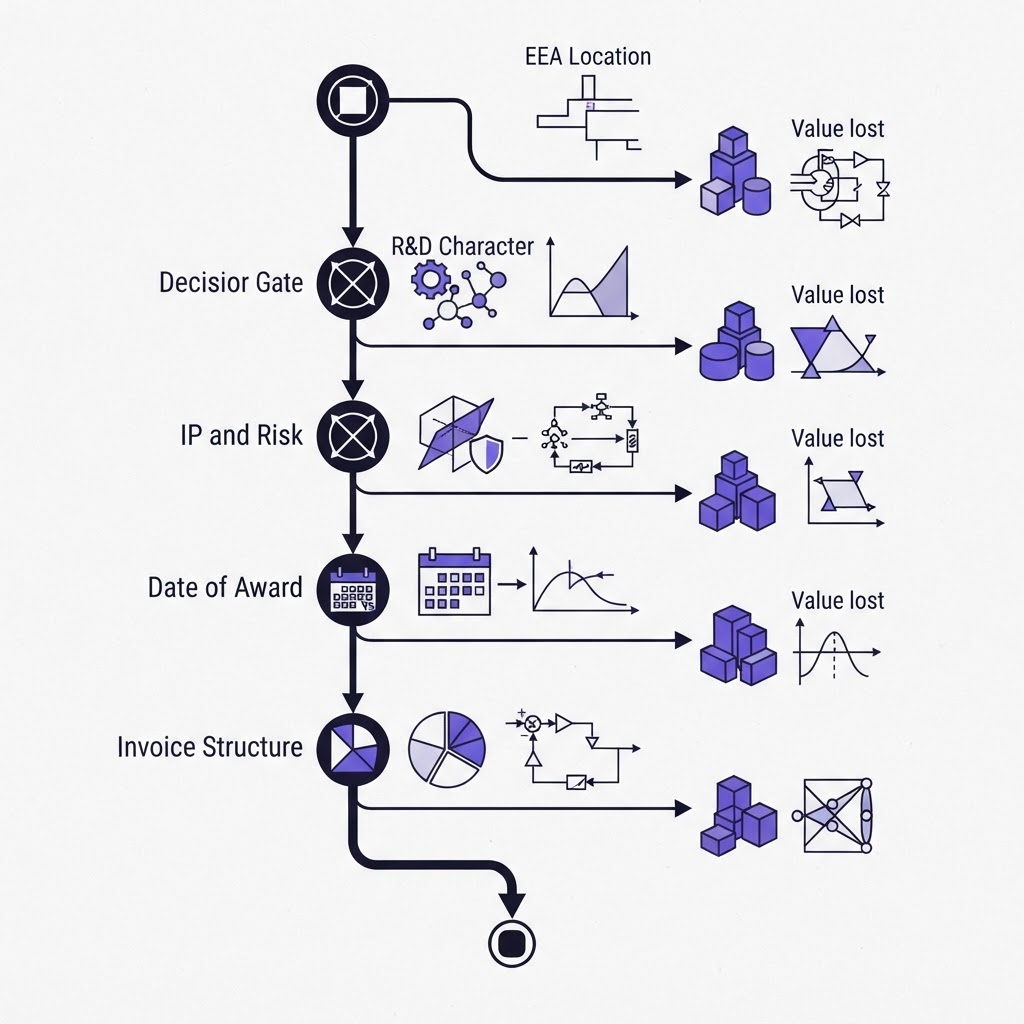
The German R&D tax credit, the Forschungszulage, does not treat a fee paid to an external research partner the way it treats your own payroll. Contract research enters the calculation at 70 percent of what you pay, only the client may claim it, and if the contractor's place of management sits outside the European Economic Area the entire fee produces nothing. Those three facts decide more money than anything you will do at year end, and all three are settled at the moment you pick a partner and sign a contract.
This is written from the contractor's side of that table, which is the side the tax literature never covers. Equation Labs delivers contract research programmes for German clients, and its research work is eligible under the FZulG. What follows is the rule, and then the part nobody writes down: what a client should demand in the scope so that the claim still stands up two years later.
What the 70 percent rule says
The statute is short about it. For research and development projects commissioned after 27 March 2024, eligible expenditure is 70 percent of the fee the client incurs for the contract, against 60 percent for projects commissioned before 28 March 2024, and the allowance is 25 percent of the assessment basis with an additional 10 percentage points available to SMEs.
Two details in that sentence do real work.
The date that decides 70 or 60
The trigger is the award of the contract. What matters is the date the contract was placed, not when the project starts and not when the invoice is paid. A long framework relationship signed in early 2024 can therefore be sitting at 60 percent while work performed today under a fresh contract sits at 70. Where the relationship is old and the work is new, place the new work under a new, dated order.
Why the legislator stopped at 70
The missing 30 percent is not a penalty and not an estimate you can argue with. The legislator assumes the remainder covers the contractor's profit margin, administrative overhead and other non-research costs, and the flat rate was designed deliberately so that there is no requirement to disclose or verify the contractor's actual cost structure. That is a feature. Your contractor never has to open its books to your tax office, and you never have to negotiate a cost breakdown you have no way of auditing.
Only the client claims, and the contractor never does
In contract research the claimant is the client. The eligible expenses can only be claimed by the client and not by the contractor, because two taxpayers cannot claim relief for the same underlying R&D activity.
The certification office states the same thing from the contractor's end: work a company performs on behalf of third parties is excluded from its own in-house R&D under the FZulG, and in that case the client is the one who may claim. So the question "is my contractor also claiming this?" has exactly one acceptable answer, and it is worth a line in the contract rather than a phone call in year three.
There is a second exclusion that clients discover late. Where the contractor passes part of the project on to a sub-contractor, the fee for that sub-contract is not eligible expenditure. Only what your direct contractor performs itself counts. A partner that quietly brokers the interesting half of the work to a third party is not just a delivery risk, it is a measurable reduction in your assessment basis. Ask who executes, by name, before signature.
The EEA seat test comes before any technical question
This is the filter that disqualifies the most money, and it has nothing to do with research quality. A project commissioned abroad is eligible only if the contractor is based in an EU member state or another EEA state that, under a contractual obligation, provides mutual assistance to the extent needed to review the eligibility requirements.
In practice that means third countries are out entirely. The United Kingdom has counted as a third country since 1 January 2021, and neither Switzerland nor the United States belongs to the EEA, so an excellent research partner at a British or American university generates no eligible expenditure at all. Place of management decides, not the quality of the science.
Which is why the seat belongs in the shortlist criteria and not in the tax review. Equation Labs S.L. is registered in Las Palmas de Gran Canaria, Spain, inside the EEA, and that is a procurement fact for a German client rather than a piece of company trivia.
What the relief is worth in 2026
Take the standard worked case. A German SME commissions a research institute and pays 200,000 euros. Seventy percent is eligible, so the basis is 140,000 euros, the SME rate of 35 percent applies, and the allowance comes to 49,000 euros, or 35,000 euros at the 25 percent rate for a company without SME status, against zero for the identical order placed with a partner in a third country.
Two changes took effect on 1 January 2026 and neither is widely priced in yet. The maximum assessment basis rose to 12 million euros per year, a 20 percent overhead flat rate was introduced, and the maximum allowance is now 3 million euros at the standard rate or 4.2 million for SMEs; the allowance is a legal entitlement with no competitive application window, offset against the next tax assessment and paid out in cash where it exceeds the liability. That last clause is what makes the instrument useful to a loss-making company: the benefit does not depend on being profitable.
The overhead flat rate is the part most often missed on contract research specifically, because it is applied on top of the 70 percent basis rather than instead of it. Two ceilings sit above all of this: total state aid for one R&D project, including the research allowance, is capped at 15 million euros per company and project, and cumulation is excluded where the same eligible expenses already form part of the basis for other EU-funded grants.
The five conditions a contract has to meet
The IP condition is the one that collides with a research partner's standard terms most often, and it is not a detail you can paper over in an annex. If the contractor keeps the rights, you may not have commissioned contract research in the eligible sense at all.
The contract type matters too. A services contract exists where the contractor owes only an approach consistent with the rules of science and technology, while a works contract exists where a defined result is owed, and success-dependent remuneration is an indicator of the latter. Both can qualify. The reason to decide consciously is that genuine research has an uncertain outcome by definition, and a contract that promises a result is a contract someone will eventually have to explain.
The two-step application, and where contract research gets inspected
Filing happens twice, in two different places, and the second one is where invoices get read.
One requirement in that application shapes how a contract research programme should be structured from the start. A tabular work plan is mandatory for every project, and where a project is commissioned in whole or in part, each contractor must appear in at least one work package. A programme sold to you as four months of effort cannot be entered into that form. A programme decomposed into named work packages can.
Then the tax office, per fiscal year. One certificate covers a whole project across several annual filings, submitted through Mein ELSTER, where gross salaries, timesheets, employment contracts and invoices for contract research are reviewed in detail; the project filed must be substantially the one described to the BSFZ, and audits do occur, particularly at larger amounts.
What to require from a contractor so the claim survives
Every rule above converts into a clause or a deliverable. The short version of what a client should insist on:
- Work-package decomposition that can be dropped into the BSFZ work plan without being rewritten.
- Invoices split into R&D and non-R&D line items. The R&D portion is identified first and only then reduced to 70 percent, so a blended invoice either understates your basis or invites an argument.
- A written statement that the contractor is not claiming the same work as its own research.
- Disclosure of any sub-contracting, since that portion is not eligible.
- IP assignment and economic risk sitting with you, stated explicitly.
- A transfer package complete enough that someone else could re-run the work.
We structure programmes that way because they were built to be audited. OptiVX ran as work package AP1, Core AI and ML models, as primary R&D partner to Gemino across 29 accounted work phases, with 400 simulated years certified and a measured 31 percent yield increase, and its IP patent was filed in July 2026 and is pending; IntelliBot ran as work package AP3, Predictive validation, for MindWaves AI Solutions GmbH across 4 workstreams with 8-node horizontal scaling, closing with more than 400 pages of transfer documentation.
Twenty-nine accounted phases is not a marketing number. It is the granularity at which a work plan, an invoice and a certificate can be made to agree. If you are still deciding what you are buying before you get to how it is documented, start with what contract research and development actually is and then the commercial questions in buying contract research and development services.
The decision order that saves the most money
- Is the contractor's place of management in the EEA? If not, stop.
- Is the work research, or is it testing, integration and consulting wearing a research label?
- Do you hold the IP and bear the economic risk?
- Is the order dated after 27 March 2024?
- Does the contract name work packages and split the invoice?
- Has the BSFZ application been prepared from those same work packages?
Every one of those is decided at or before signature. None can be repaired in a year-end review, which is the point at which most companies first ask the question.
FAQ
What percentage of contract research is eligible for the German research allowance?
Seventy percent of the fee for projects commissioned after 27 March 2024, and 60 percent for those commissioned before 28 March 2024. The calculation runs in two steps on a mixed invoice: the R&D portion is identified first, and 70 percent of that portion becomes the assessment basis. On a 500,000 euro invoice of which 400,000 relates to R&D services, the basis is 280,000 euros, and the funding rate of 25 percent, or 35 percent for an SME, applies to that figure.
Can the contractor claim the German R&D tax credit as well?
No. In contract research only the client is entitled, and the contractor may never claim relief for work performed under the contract. A contractor that runs separate, independent research projects of its own can of course claim for those. Both parties claiming the same costs is impermissible double funding and can lead to reclaim and sanctions.
Does contract research with a UK or Swiss partner qualify?
No. The contractor's place of management must be in an EU or EEA state. The United Kingdom has been a third country since the Brexit transition ended on 1 January 2021, Switzerland has never been in the EEA, and neither has the United States. The whole fee falls out of the basis, whatever the research is worth scientifically. Where the work genuinely has to sit outside the EEA, look at European programmes that admit third-country partners on their own terms instead.
What happens if the contractor sub-contracts part of the work?
The fee attributable to the sub-contract is not eligible expenditure. Only the share the direct contractor performs itself counts toward the basis. This is a good reason to ask who executes each work package by name during scoping, because the answer changes what the programme is worth to you after relief.
Do you need the BSFZ certificate before signing the research contract?
No. The certificate can be applied for before, during or after a project, and it can be issued for past fiscal years, the current one and up to three full future years. Applying early buys certainty rather than eligibility. What cannot be fixed retrospectively is the contract itself, so the seat, the IP terms and the work-package structure are the things to settle first.
This article describes the statute and published official guidance. It is not tax advice, and the claim itself is filed by the client together with its own adviser.