
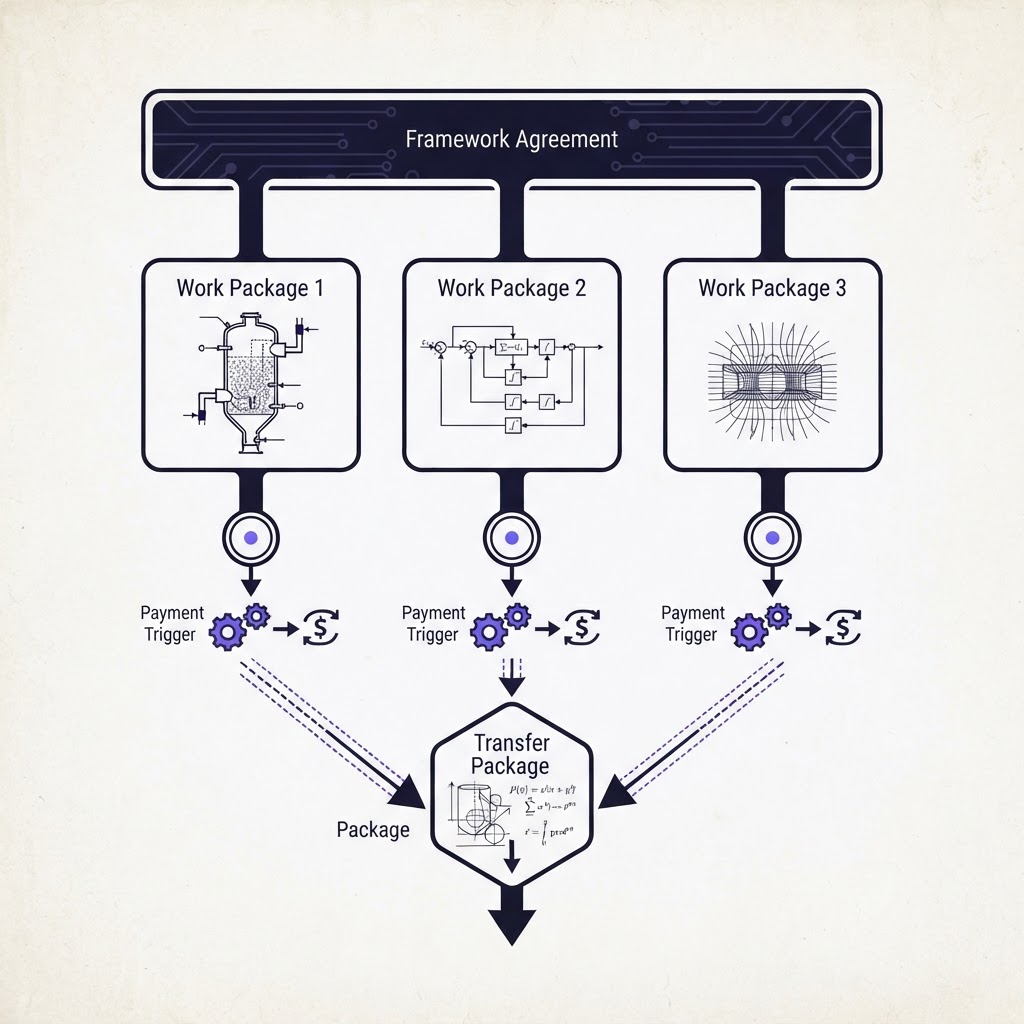
Ask what contract research and development is and the first page of results answers with drug trials. That answer is right for one industry and misleading for every other one. The general definition is simpler: contract research is the activity by which a client hires the services of an external organization to carry out a specific piece of R&D. The contract fixes the approach to be used, the milestones, the project costs, the assignment of intellectual property rights, the obligations of each party, and a description of the desired end product.
Nothing in that is about pharmaceuticals. The reason the search results are is that the acronym CRO was captured by life sciences, where a contract research organisation is defined as a person or organisation contracted by the sponsor to perform one or more of the sponsor's trial-related duties. That is a definition of an organisation type, not of a contracting mode. Contract R&D is a contracting mode, and it is used to develop materials, control systems, process equipment and software just as routinely as it is used to run clinical trials.
Two boundaries that decide whether it is contract R&D at all
It is not a testing laboratory
The cleanest distinction in the literature is also the least cited. Testing laboratories provide analysis or testing of existing materials, products or processes. Contract R&D creates new ones, and its results are uncertain. If you can specify the output precisely enough to write an acceptance test at the outset, you are probably buying a service, not commissioning research.
It is not routine engineering either
There is a formal test for this, and it is the same one a funding body or a tax authority will apply to you. The Frascati Manual sets five core criteria: the activity must be novel, creative, uncertain, systematic, and transferable or reproducible. All five have to be met, at least in principle.
Read them as a filter rather than as a definition. Novel and creative rule out reimplementing something known. Uncertain rules out work whose outcome you can already forecast. Systematic rules out unplanned tinkering, because the work has to be planned and budgeted. Transferable rules out a result that lives only in one engineer's head. That last one quietly sets the documentation standard for the entire programme.
Contract research, collaboration, consultancy and grants are four different things
They get used interchangeably and they carry different consequences.
Contract research is fees for services. One party pays, the other performs. A real collaboration is the arrangement where both parties render services, which changes almost every downstream clause. The structural consequence of the first is worth stating plainly: in a research services contract the provider generally has no further involvement in the project after the agreement ends and does not acquire or retain rights in it. You buy the work and the results, and the relationship closes.
Research institutes formalise the same distinctions further. One Indian government institute's contract research guidelines separate sponsored projects, wholly funded with defined objectives and generally culminating in generation of intellectual property, from collaborative projects, grant-in-aid projects, and consultancy projects. Consultancy in that taxonomy is a feasibility study, a systems study or supervision of an implementation. It is advice, not new IP. Commissioning a consultancy and expecting a patentable result is one of the more expensive category errors available.
How a contract R&D programme is actually structured
This is the part no glossary covers, and it is where a programme succeeds or turns into an invoice dispute.
Work packages, milestones and acceptance criteria
The unit of a research programme is the work package: a detailed description of a block of work in the project plan, with clearly defined deliverables against it. Milestones are generally set out in that same project plan, and payment obligations are linked to their achievement rather than to a calendar. Where the programme is large enough, a joint steering committee decides what happens when the work and the plan diverge.
Three further clauses do most of the work in practice. Measurable milestones need acceptance criteria and a testing or validation process, a change control process for when scope evolves, and an explicit funding model: fixed fee, cost-plus, milestone payments or matched contributions. Scope in R&D moves by definition, since uncertainty is one of the five criteria. A programme without change control is a programme that will renegotiate itself informally, under time pressure, at the worst possible moment.
For a long relationship the usual pattern is a framework agreement plus individual work orders, rather than a new single agreement each time. The framework carries the IP, confidentiality and liability terms once. The work orders carry the technical scope.
What that looks like on a real programme
Our own two delivered contract programmes, documented at Equation Labs, were structured exactly this way. OptiVX ran as work package AP1, Core AI and ML models, as primary R&D partner to Gemino, across 29 accounted work phases, and produced a measured +31% yield increase with 400 simulated years certified. IntelliBot ran as work package AP3, Predictive validation, for MindWaves AI Solutions GmbH, across 4 workstreams with 8-node horizontal scaling.
The numbers that matter there are the structural ones. Twenty-nine accounted work phases is not a project management flourish. It is what makes a research programme auditable after the fact, by the client, by a certification body, and by whoever eventually assesses the tax claim.
Who owns the results: background, foreground and sideground IP
Every serious research contract splits IP three ways, and the vocabulary is worth learning before you negotiate rather than during.
Background IP is what a participant holds at the commencement date and contributes to the project. It is better listed explicitly, often as an attachment, than left to inference, because a vague definition can pull in IP created elsewhere in the organisation. Foreground IP is what the project produces. Sideground IP is created after commencement but outside the project, and the category exists precisely so that unrelated work happening in parallel is not swept into the deal.
The defaults: each participant keeps its own background and sideground IP, and in contract research it is usually the funder who owns the foreground IP. Note also that access rights and licences are different animals. A right to review the other side's results is not a right to use them.
This is not abstract. A contract programme that works produces an asset with a filing date, which is why the OptiVX IP patent was filed in July 2026. Which raises the question this article does not answer, what it costs to file a patent, and which is worth pricing before the ownership clause is agreed rather than after.
The transfer package is the deliverable, not the demo
A working prototype at the end of a programme proves the contractor can do the work. It does not prove the client can continue without them, and that gap is where contract research most often disappoints.
The remedy is unglamorous. Contemporaneous records of research activities, personnel assignments and deliverables are what later prove what was actually developed and by whom, and they are the evidence base if anything is disputed. Recall the fifth Frascati criterion: transferable and reproducible. A programme that cannot be handed over has arguably failed the definition of R&D, whatever it demonstrated.
IntelliBot closed with 400+ pages of transfer documentation. That is the deliverable. A validation record of the kind OptiVX produced attaches to one specific model and is expensive to regenerate, so the moment it is not transferred it stops being an asset and starts being a dependency. The same logic drives our engineering choices downstream, including how we approach knowledge distillation vs quantization when a validated model has to be compressed for deployment, and how sim-to-real transfer is certified before a controller touches a live process.
Who gets to claim the tax relief
Contract R&D is subsidised in most developed economies, and the rules decide which of the two parties benefits. They also decide where your contractor should be incorporated.
Germany: the 70 percent rule
Under section 2(4) of the Forschungszulagengesetz, contract research exists when a taxable company commissions an external provider, which may be a university, a research institute, an engineering firm or another company, to carry out R&D. Three rules follow, and they surprise people:
- Only the client may claim. The contractor may not additionally claim those costs as its own R&D, which prevents double funding of the same project.
- 70% of the fee is the eligible basis. A deliberate flat rate, assumed to strip out the contractor's margin and overhead. There is no requirement to disclose the contractor's actual cost structure.
- The contractor must be in the EEA. That excludes the USA, China, India and, since Brexit, the UK. This is a common and expensive stumbling block.
On top of that basis, the support rate is 25% for all companies and 35% for SMEs, with the annual cap rising to EUR 12 million from 1 January 2026, and sub-contract costs passed on by the contractor are not eligible. Equation Labs research work is eligible under the FZulG, which is a function of where the company is seated as much as of what it does.
The UK asks a different question
The UK test is about intent rather than geography. R&D is contracted out where, having regard to the terms of the contract and the surrounding circumstances, it is reasonable to assume the customer intended or contemplated that R&D of that sort would be done. The circumstances HMRC weighs include IP ownership, who carries the financial risk, how much autonomy the contractor has in execution, and whether the contractor evidently specialises in providing R&D services.
Read that list again next to the IP section above. The clauses you negotiate for commercial reasons also determine, in retrospect, who was doing the research.
What to ask before commissioning a programme
- Is the work novel and genuinely uncertain, or is it engineering you have not scheduled yet? If it fails the five criteria it is not R&D and no relief applies.
- Is each block of work a work package with an acceptance test, or a paragraph of intent?
- What is on the background IP list, in writing, from both sides?
- Who owns the foreground IP, and is the transfer an assignment or a licence?
- What is in the transfer package, page count and all, and when is it delivered?
- Is the contractor seated where your relief regime requires?
- Is there a change control process, agreed before the first thing changes?
The method we apply on the technical side is the same one that answers most of these: derive the equations of the process first, then build the controller that holds it in place, then hand over the record that lets someone else re-run the whole thing. That principle also governs how we scope contract R&D for industrial control, and it is why the German research allowance and the 70 percent rule belong in a scoping conversation rather than in a year-end tax review.
FAQ
Is contract R&D the same as outsourcing?
No. Outsourcing moves a known, repeatable activity to a cheaper or more specialised provider, and you can write a service level for it. Contract R&D commissions work whose outcome is uncertain by definition, which is one of the five Frascati criteria. That is why these agreements carry milestones and acceptance criteria rather than availability targets.
Can a contract research project fail and still be paid for?
Usually yes. Uncertainty of outcome is part of the definition of R&D, so what is being bought is defined effort against work packages, not a guaranteed commercial result. Payment obligations are typically linked to the achievement of milestones set out in the project plan, which is the mechanism that keeps that fair to both sides.
Who can publish the results of contract research?
It depends on the publication clause, and it matters more than most clients expect. The institute guidelines cited above require the client to be consulted before any research results arising from contract work are published. The commercial reason is novelty: publishing before a patent application is filed can destroy it.
What is contract research called in Germany?
Auftragsforschung. It is defined in section 2(4) of the Forschungszulagengesetz, and the contractor can be a university, a research institute, an engineering firm or another company.