
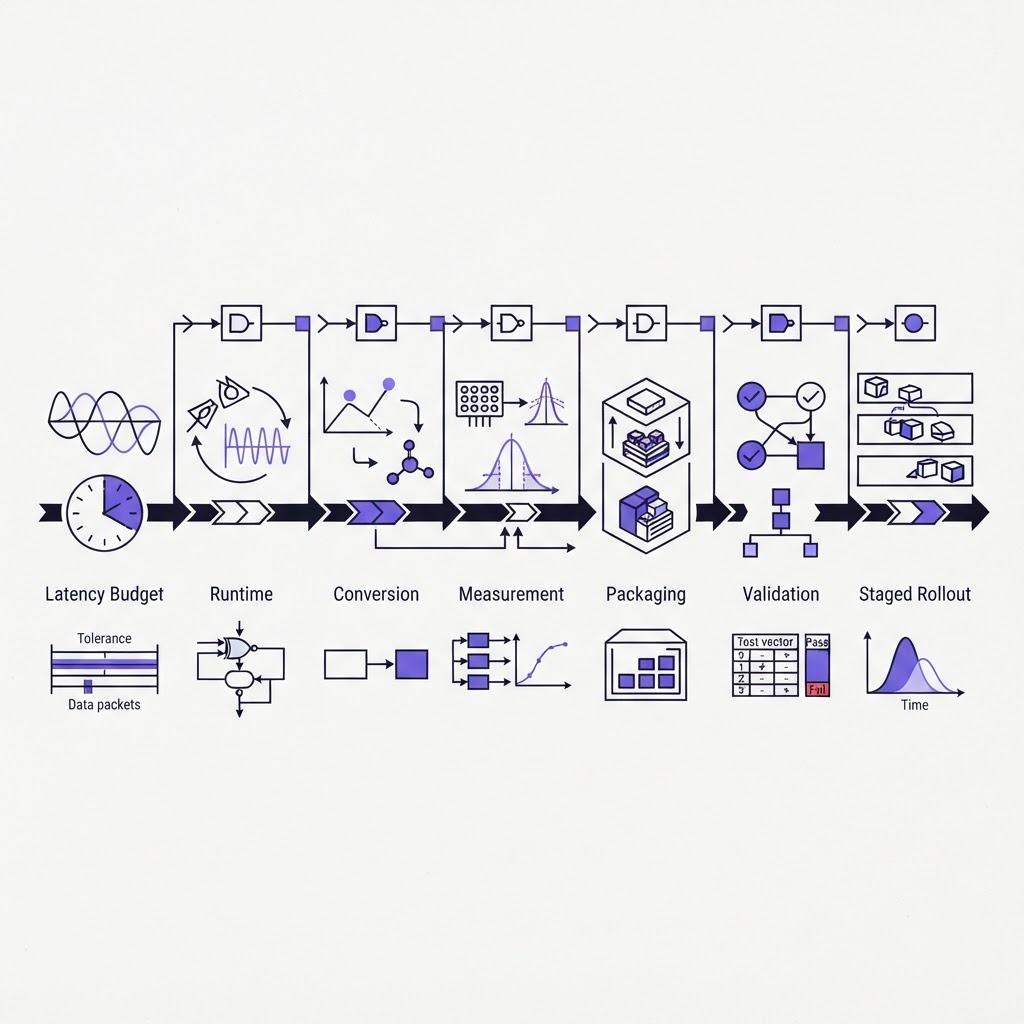
Most guides to an edge AI deployment pipeline describe fleet logistics. Convert the model, package it, push it over the air, watch a dashboard, roll back when something breaks. That is correct and it is incomplete, because it assumes the worst a bad release can do is misclassify a frame.
Attach the model to a live process and the question changes. A controller that answers late has acted on a state that no longer exists, and a controller nobody can show was validated should not be acting at all. The pipeline's output is then not a model file on a device. It is a release plus the evidence that justifies running it.
What follows is that pipeline, stage by stage, with the measured numbers that decide each gate.
A pipeline that ends in evidence, not a model file
The usual shape comes from the literature. A PRISMA review of neural networks on embedded systems derives five stages: requirement definition, model selection, optimization, hardware alignment and deployment. It is a sound skeleton, and it stops exactly where operational trouble starts, at the moment the model ships.
The same review names what the field still lacks: limited support for ultra-low-precision inference, variability in hardware toolchains, and no standardised holistic benchmarking. Read as a pipeline designer, that list says the evidence will not be handed to you. Every stage below exists to produce a number or an artefact someone can check later.
Stage 1: Take the latency budget from the process
The deadline is set before any architecture is chosen, and the process sets it. A study of latency-aware edge architectures for industrial IoT reports achievable budgets of roughly 1 ms for servo loops and 6 to 12 ms for machine vision when edge compute is paired with deterministic networking, partitioned across communication, computation and execution.
Inference is one term in that partition. A practical edge deployment workflow makes the same point for products: inference time alone is not product latency, because capture, preprocessing, post-processing, output and logging all spend from the same budget. Write the budget down per stage before anyone opens a training notebook. The inference allowance is whatever remains.
Stage 2: Freeze the hardware and runtime first
That workflow also argues the deployment path should be designed before the hardware is frozen, because accelerator, memory, storage layout, update method and thermal budget all decide whether the model can be maintained after launch. We would go one step further: fix the runtime too, and benchmark it before compressing anything.
The reason is how much the runtime alone moves. A benchmark of edge inference frameworks for industrial machine vision found OpenVINO cut YOLOv8 inference time by 30 to 60 percent on Intel desktop CPUs. On the Jetson CPU the ranking inverted: Grounding DINO ran at 13580 ms under ONNX Runtime against 102720 ms under OpenVINO, the same model on the same board. No datasheet predicts that.
At the small end, hardware dictates the whole toolchain. TI's MSPM0 deployment guide trains with quantization-aware training in PyTorch, exports to ONNX, and compiles through a TVM-based neural network compiler into a static library for an 80 MHz Cortex-M0+ with 128 kB of flash and 32 kB of SRAM. On a target like that, the pipeline is chosen for you. On a larger edge box it is not, and choosing it late is the most expensive mistake available.
Stage 3: Convert, then prove the conversion
Conversion is where platform assumptions break. The embedded workflow lists the symptoms: a model may convert successfully and still run slowly, use too much memory, or produce slightly different outputs, because each runtime supports different operators with different numerical behaviour.
Compression belongs in this stage and it is measured in wall clock, not parameter count. We covered ordering and operator choice in edge AI model compression, and the training cost trade in post-training quantization vs quantization-aware training.
Golden outputs on the target
The check that catches silent numerical drift is simple. A guide to safe edge rollouts ships a validation kit with every model: a small on-device test set with golden outputs, run after install to confirm results within tolerance. For a controller, generate the goldens from the reference model on recorded process trajectories, and set the tolerance from what the control law can absorb, not from a classification accuracy delta.
Stage 4: Measure on the target, including the tail
A single timed forward pass on a warm cache is not a measurement. The industrial benchmark above used a protocol worth copying outright: 1000 inference repetitions, the first 10 discarded for warm-up, batch size 1 to match deployment, device synchronisation on GPU, mean and standard deviation over the remaining 990.
Two further conditions matter. Measure under thermal soak, since the embedded workflow warns a fanless model meeting its target for five minutes may fail after an hour in the final enclosure. And measure the tail, not the mean. A review of timing guarantees for DNN inference in embedded systems treats predictable execution under strict deadlines as an open problem, naming multi-DNN scheduling and heterogeneous resource management as obstacles. If two models share the board, their interference is part of your latency and appears in neither model's benchmark.
Stage 5: Package a release, not a file
A release that is a folder of copied files cannot be audited. The embedded workflow lists what a model release should carry: the model in its deployed runtime format, preprocessing rules, runtime and accelerator SDK version, confidence thresholds, hardware target and memory requirement, validation dataset reference, rollback compatibility, and a release identifier visible in field logs.
Two structural rules keep that release recoverable. A CI/CD pattern for edge models on Triton and ONNX keeps model files in a repository separate from the runtime image, so a new model version does not rebuild the runtime and rollback is a pointer swap. And an account of edge AI OTA failures argues firmware, model and configuration must be released separately, because a bound update produces states like a new model arriving on firmware that cannot run its preprocessing path.
Stage 6: The validation gate
Here the fleet guides and our pipeline diverge. Their gate is a health check: did the service start, is the error rate normal. Ours is evidence: is this exact artefact the one the validation campaign was run against, and does the campaign still hold.
Our control stack, built through the OptiVX and IntelliBot contract research programmes, runs end-to-end edge inference at 285 ms, down from 1.2 s, with growth-model accuracy at R-squared above 0.95, validated on a 500 L pilot basin with zero safety violations across 400 simulated years. The IntelliBot work transferred with more than 400 pages of documentation. Those pages, not the weights, are what a client or funder accepts.
So the gate asks three questions. Did the converted artefact pass its golden outputs within control tolerance. Did the measured tail on target, under soak, fit the Stage 1 budget. And does the change leave the validation evidence standing. A quantized model with the graph unchanged can have its evidence argued forward and rechecked. A retrained or distilled model is a different function, and its sim-to-real transfer campaign runs again.
Two latency tiers, two release cadences
The safety layer in our stack answers in under 2 ms, beside a 285 ms model tier. That split is also a pipeline decision. The safety filter, built on control barrier functions, changes rarely and under the strictest gate. The learned model can iterate faster precisely because the layer beneath it bounds what a bad release can do. A pipeline that ships both through the same cadence is either too slow for the model or too loose for the guarantee.
Stage 7: Stage, observe, roll back
Once released, the pipeline becomes a loop. The rollout guide describes five loops running together: packaging, delivery, activation, observation and adaptation. Its most useful idea for a controller is the fallback rule, explicit conditions for switching to a smaller model, a heuristic, or another path when the accelerator is unavailable or the device is out of envelope. For a process controller, the fallback is a conservative control law that needs no model.
Observation has to catch what never throws an error. Edge MLOps practice frames the core problem as a model whose accuracy silently drifts against a world that changed after the device shipped, on hardware with intermittent connectivity and no engineer on site. Rollout is staged, a single unit or basin first, and rollback triggers are written before the release, never during the incident. Where a new site demands a different split between cloud, gateway and machine, that is a separate decision covered in edge AI deployment strategies.
The pipeline on one page
| Stage | Gate artefact | Fails when |
|---|---|---|
| 1. Budget | Per-stage latency allocation | Inference is given the whole deadline |
| 2. Hardware and runtime | Baseline benchmark on target | Runtime chosen after compression |
| 3. Convert | Golden outputs within control tolerance | Outputs differ silently |
| 4. Measure | Tail latency under soak, 1000 runs | A warm single pass is reported |
| 5. Package | Versioned manifest, separate model and firmware | Files are copied by hand |
| 6. Validate | Evidence tied to this exact artefact | Model changed, campaign did not |
| 7. Operate | Staged rollout, fallback law, drift monitor | Rollback is improvised |
This is the method we bring to contract research and development services when a model has to leave the notebook and hold a real process in place.
FAQ
What is an edge AI deployment pipeline?
The repeatable path from a trained model to a validated, versioned release running on target hardware, plus the monitoring and rollback that follow. The embedded workflow defines it as packaging, converting, installing, validating, updating and monitoring a model on an edge device.
How is edge MLOps different from cloud MLOps?
You cannot redeploy a container and call it done. Devices are physically distributed, often with intermittent connectivity and no on-site engineer, so updates must be signed, validated before activation, and automatically rolled back when they underperform.
Should the model and firmware be updated together?
No. Release firmware, model and configuration as separate artefacts with compatibility checks. Bundling them creates partial states, such as a configuration pointing at a model that has not finished downloading, that a staged rollout exposes only at fleet scale.
Can an edge AI deployment pipeline target a microcontroller?
Yes. TI's flow quantizes during training, exports to ONNX and compiles to a static library linked into firmware, running on a Cortex-M0+ with 32 kB of SRAM. The later stages, measurement, packaging and rollback, still apply.