
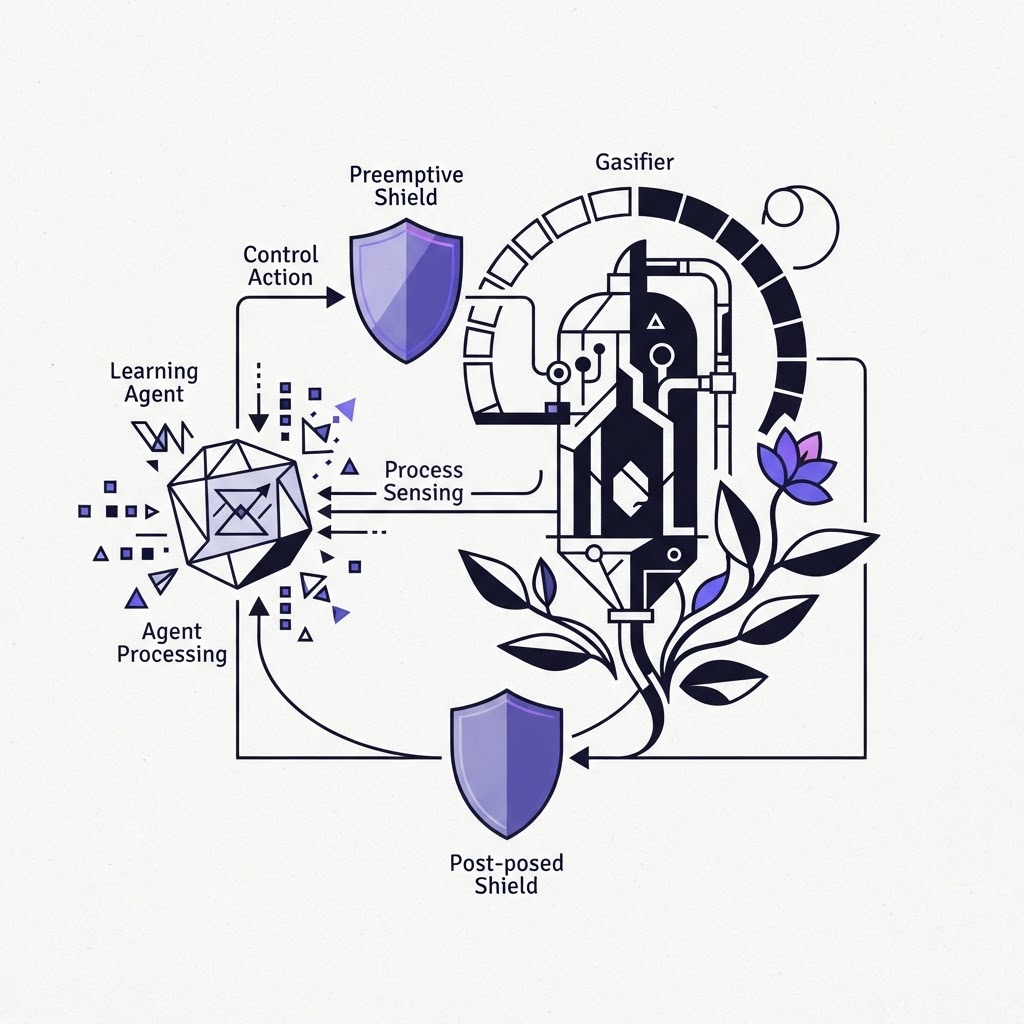
Safe reinforcement learning via shielding puts a small, verified component between a learning agent and the system it controls. The agent optimises reward. The shield decides which of its actions are allowed to reach the actuators. The appeal is a clean division of labour: the policy can be as large and opaque as you like, because the safety argument never has to look inside it.
That division is real, and it is the reason shielding keeps appearing in proposals for learned controllers on physical equipment. But the guarantee is not free. It is transferred from the policy onto something else, a model of the environment, and that model is where a shield succeeds or fails in deployment. This article explains how a shield works, from the papers that define it, then sets out where it breaks on a continuous process and how it compares with the two alternatives an engineer will actually weigh: a barrier-function safety filter and a rule-based runtime gate.
What a shield is
The term comes from the original shielding paper by Alshiekh, Bloem, Ehlers, Könighofer, Niekum and Topcu. Given a safety specification written in temporal logic, they synthesise a reactive system, the shield, that monitors the learner and corrects its actions only when the chosen action would violate the specification. The shield is computed upfront from two inputs: the safety part of the specification and an abstraction of the environment dynamics.
Correctness and minimum interference
A shield enforces two properties. Correctness means the specification holds at run time, during learning and during execution, regardless of how fast the learner converges. Minimum interference means the shield restricts the agent as rarely as possible, forbidding an action only if it could endanger safe behaviour. The paper proves its constructed shields are the minimally interfering ones among all shields that enforce the specification on every environment the abstraction covers.
The authors also note two properties that matter to practitioners. The correctness guarantee depends only on the monitored input and output behaviour, the abstraction and the specification, not on the internals of the learning algorithm. And the framework is compatible with function approximation, which is how it reaches deep RL.
Preemptive versus post-posed shielding
The shield can sit in one of two places. A preemptive shield acts before the agent decides, handing it a list of safe actions to choose from. A post-posed shield sits after the agent, forwards its action unchanged when that action is safe, and substitutes a safe one when it is not.
Post-posed shielding raises a question preemptive shielding avoids: when the shield overrides the agent, what reward should the agent learn from for the action it proposed but never executed? The paper treats this explicitly, and anyone implementing a post-posed shield has to make the same choice, because it shapes what the policy believes about its own unsafe proposals.
How a shield is built
From specification and abstraction to a safety game
Construction is a game. The specification automaton and the environment abstraction are combined into a two-player safety game: the environment chooses the next observation, the system chooses the next action. Solving the game yields a winning region, the set of states from which the system can keep the specification satisfied forever. The shield is the strategy that keeps play inside that region. It must also always offer at least one available action, otherwise it has simply moved the failure from "unsafe action" to "no action".
Notice what the proof actually says. If the real environment behaves as the abstraction claims, the specification holds. The learner is irrelevant to the argument. The abstraction is everything.
Probabilistic shields and the delta threshold
Most real environments are stochastic, and a binary safe or unsafe label fits them badly. Probabilistic shields, introduced by Jansen, Könighofer, Junges, Serban and Bloem, use model checking on an MDP to compute the probability that each action leads to a safety violation. An action is blocked if it is worse than the safest available action by more than a threshold delta. A high delta gives a stricter shield, a small delta a more permissive one, and delta can be changed on the fly. Because the analysis runs only on the safety-relevant fragment of the system, the authors report fragments at least ten orders of magnitude smaller than a full model.
Recent work pushes scalability further. Probabilistic shielding via state augmentation gives strict formal guarantees at training and test time, but under a stated precondition: the safety dynamics of the MDP are known. Hold on to that precondition. It is the one a practitioner is least able to satisfy.
Where shielding breaks on a real process
The papers are honest about their limits. What they rarely do is translate those limits into what an engineer sees on a running plant. Four matter most.
The abstraction is the guarantee
A shield is correct with respect to its abstraction. On gridworlds and games, the abstraction is exact by construction. On a bioreactor or a gasifier, it is a discretisation of continuous, nonlinear, partially known dynamics, built by someone, validated against some data. If the plant drifts outside what the abstraction allows, the proof no longer applies and nothing in the shield will tell you so. The practical consequence: the validation effort for a shielded controller belongs almost entirely to the model, not the policy. Budget accordingly.
State explosion and the timing budget
Könighofer's work on online shielding states the scaling problem plainly: offline shield synthesis requires exhaustive analysis of every state and action combination, so its complexity grows exponentially in the state and action dimensions. The workaround in the literature, coarse abstractions and over-approximations, tends to make the shield over-restrictive.
Online shielding instead computes the safety of actions between decision states. It scales much better, but the same paper is explicit that the approach provides no worst-case computation time, so it only applies where the agent has a safe alternative such as waiting when the analysis has not finished. A fixed-rate control loop has no such luxury. On a plant, "no worst-case bound" translates directly into "cannot be certified against the loop period".
Partial observability
Industrial processes rarely expose their full state. Carr, Jansen, Junges and Topcu extended shielding to partially observable settings, reasoning over belief supports rather than states. In their experiments only shielded agents never violated the specification, and shielding improved convergence. They also flag a design trap: shields for pure avoid specifications can block every action and deadlock the system, which is why they use reach-avoid specifications instead.
Conservatism and the cost of removing the shield
Shields restrict exploration. The probabilistic shielding paper names this directly: shielding may lead to suboptimal policies, and the trade-off between performance and safety is intricate. The tempting response is to train with the shield and then remove it. The partial observability study tested exactly that. Agents kept their better performance after the shield was phased out, but even smooth deactivation did not prevent safety violations completely. On a live process, removing the shield means accepting that the policy alone is now the safety argument.
Shields, barrier functions and runtime gates compared
A shield is one of three runtime mechanisms that get proposed for a learned controller. They differ in what they need and where they fit.
| Shield | Barrier-function filter | Rule-based gate | |
|---|---|---|---|
| Model needed | Discrete abstraction or MDP of safety-relevant dynamics | Differentiable, control-affine continuous model | Named constraints and a simulator or twin to test proposals |
| Action space | Discrete, or discretised | Continuous | Setpoints or supervisory commands |
| Guarantee | Temporal logic specification, including sequences | Forward invariance of a safe set | Only what the named constraints check |
| Runtime cost | Table lookup, or online model checking with no worst-case bound | One small optimisation per control step | One constraint check per proposal |
A control barrier function safety filter projects each continuous action onto the admissible set at every step. It suits fast continuous actuation, but carries its own conditions, which we cover in safe reinforcement learning with control barrier functions.
The third option is simpler than either. A preprint on a safety-gated supervisory controller for a distillation benchmark puts a rule-based gate with nine pinned constraints in front of a learned supervisor and leaves the regulatory layer unchanged. Its numbers are instructive in both directions. The gate corrected 318 actively harmful proposals. But 534 of 590 gate interventions were cases where the operating specification sat on a safety limit, so the gate was reacting to the specification's geometry, not to bad behaviour from the supervisor. A gate, like a shield, is only as good as the constraints it is given, and interventions have to be read, not just counted.
A decision rule
- Choose a shield when actions are discrete or naturally discretised (mode switches, valve states, recipe steps), when the safety requirement is about sequences ("never open B within ten minutes of closing A"), and when you can defend a finite abstraction of the safety-relevant dynamics.
- Choose a barrier-function filter when actuation is continuous and fast, and you have a model accurate enough to differentiate.
- Choose a rule-based gate when the learned component writes setpoints to an existing regulatory layer, and the safety case is a short list of named limits the operators already recognise.
These combine. A common pattern is a gate or shield at the supervisory layer and a barrier-function filter at the actuator layer. More on how that fits a full plant stack is in safe reinforcement learning for industrial process control.
What we measure before a safety layer goes near a plant
Whichever mechanism wins, the questions we ask are the ones the papers leave to the reader. Does the safety layer answer inside the loop period with margin, on the deployment hardware? Is the model it relies on validated where the process actually operates? How often does it intervene, and why?
In our own control stack the safety layer answers in under 2 ms, against an end-to-end edge latency of 285 ms reduced from 1.2 s, and the stack was validated on a 500 L pilot basin with zero safety violations across 400 simulated years. Those numbers describe one process and one stack. The practice behind them transfers: measure the safety layer's worst case as a separate budget, validate the model it trusts as rigorously as the policy, and log every intervention with its cause.
FAQ
What is the difference between preemptive and post-posed shielding?
A preemptive shield gives the agent a list of safe actions before it chooses. A post-posed shield lets the agent choose, then overrides only unsafe actions, which forces a design decision about what reward the agent learns from for the action it proposed.
Does shielding work with deep reinforcement learning?
Yes. The correctness guarantee depends on the monitored inputs and outputs, the abstraction and the specification, not on the learning algorithm, so it is compatible with neural network function approximation.
Can you remove the shield once the policy is trained?
You can, and the policy may keep its performance, but the evidence says it will not keep the guarantee. In the partial observability experiments, even gradual deactivation did not eliminate safety violations.
How do you choose delta in a probabilistic shield?
Delta sets how much worse than the safest available action an allowed action may be. Start strict during early training and on first deployment, relax it only with logged evidence, and remember it can be tightened on the fly in critical situations.