
Ask what is edge AI deployment and most answers stop at geography: the model runs on the device instead of in a data centre. That is true and it is the easy half. The harder half is what the model is doing there. A model that recommends a maintenance window can be late by a minute and nobody notices. A model that sets a pump speed on a live process cannot be late at all, because by the time its answer arrives the state it answered for is gone.
This article gives the standard definition first, then the mechanics, then the part the vendor explainers leave out: what edge AI deployment demands when the model is holding a process in place. The numbers in that section come from a controller we had to take from 1.2 s to 285 ms before it was allowed to act.
Edge AI deployment, defined
Edge AI deployment is the act of installing and running a trained machine learning model on hardware located where the data is produced, so that inference happens without a round trip to a remote server. IBM's definition is that edge AI deploys AI algorithms and models directly on local edge devices such as sensors or IoT equipment, enabling real-time processing without constant reliance on cloud infrastructure. AWS puts the consequence plainly: devices can make decisions in milliseconds without requiring an internet connection.
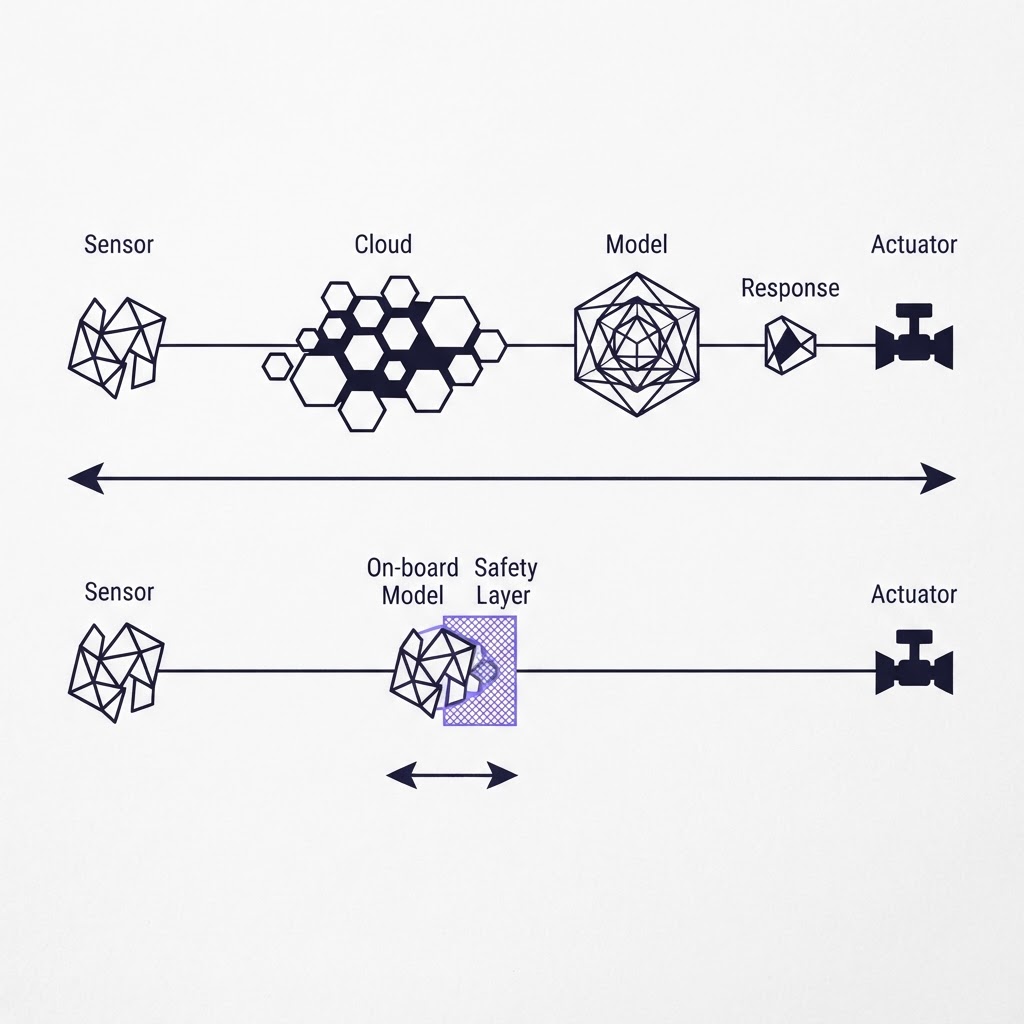
The simplest picture is the one in Microsoft's edge AI introduction. Traditional AI is device to cloud to processing to response to device. Edge AI is device to local processing to immediate response. Deployment is everything it takes to make the second line true on a specific board, for a specific model, under a specific deadline.
One distinction is missing from every definition on the first page, and it decides the whole project. Some deployments inform: a camera flags a defect, a sensor predicts a bearing failure, a person acts on the output later. Other deployments act: the output goes straight to a valve, a heater or a dosing pump. The definition is the same. The engineering is not.
How edge AI deployment works
The ACM survey of edge intelligence describes two deployment modes. In the first, the model is trained with conventional cloud resources and only inference moves to the edge device. In the second, both training and inference run on the device, which demands far more memory and compute. Almost every industrial deployment is the first kind, and this article assumes it.
Train centrally, run locally
Training happens where the data and the GPUs are. IBM notes this usually takes place in a centralised data centre or the cloud because of the data volume involved, and that after deployment, failure cases are sent back for retraining so the edge model is periodically replaced. The edge device only ever holds a trained artefact and the runtime that executes it. That is what makes the first mode feasible: the ACM survey points out that inference-only devices need to store the trained model and little else.
Convert, compress, compile
A trained model is not yet a deployable one. A 2026 ACM survey of edge AI on constrained devices splits the deployment phase into optimisation, compilation and runtime execution. Optimisation applies pruning, quantisation, kernel fusion and operator reordering to cut memory, energy and latency while holding acceptable accuracy. Compilation turns the result into a hardware-specific binary. The runtime configures execution for the goal that matters, whether ultra-low latency, energy or memory.
The same survey is frank about why this stage hurts. Toolchains are fragmented, evaluation practices are inconsistent, and without integrated frameworks the work collapses into platform-specific customisation and low-level trial and error. We have written up how the ordering of those steps changes under a control deadline in model compression for edge AI.
Push, monitor, update
AWS describes the last mile: device management tooling converts the model into binary code, installs it on the edge device, and automates testing, security and deployment so the fleet stays current. The ACM constrained-devices survey treats this post-deployment phase as its own discipline, covering monitoring, secure over-the-air updates and lifecycle management, because a model that was fast on install day will not stay correct on its own.
For the stage-by-stage version with the gates and the measurements at each one, see our edge AI deployment pipeline.
Why teams deploy at the edge
The benefit lists on the ranking pages are accurate. They read better as design constraints than as selling points.
- Latency. Processing on the device removes the round trip. A 2026 review of 141 edge AI studies found edge deployment cut application latency by over 90 percent in smart-city scenarios. For an informing deployment that is a nicer dashboard. For an acting deployment it is the difference between a controller and a log.
- Bandwidth and energy. Less data leaves the site. The edge intelligence survey cites a case where reducing communications cut energy consumption by roughly 40 percent, and the 141-study review reports quantisation alone reducing energy use by 3 to 5 times.
- Privacy and sovereignty. IBM notes that data processed locally is not exposed to another network, and that for industries under data sovereignty rules, keeping processing within the designated jurisdiction is itself a compliance mechanism.
- Resilience. Operations continue when the network does not. For a plant in rural India or on an island, that is not a bonus feature. It is the operating condition.
Each of these is also a constraint. Low latency means a small model on a slow chip. Low bandwidth means you cannot stream everything home to check it. Resilience means the device must fail safe without anyone watching. The next section is about what that adds up to.
What changes when the model is holding a process in place
Here is where our experience diverges from the explainers. In the OptiVX programme, a contract research project in closed-loop control of a biological cultivation process, the model's job was not to describe the basin. It was to govern it. Three things changed as a result.
The deadline comes from the process
In an informing deployment, latency is a quality metric: faster is better and there is no cliff. In an acting deployment the process sets a deadline, and an inference that misses it is not slow, it is wrong, because it acts on a state that has already moved on. Our control stack started with an end-to-end edge latency of 1.2 s. The process would not accept that. The deployed figure is 285 ms, and getting there took most of the pipeline described above, in that order.
The ACM constrained-devices survey names the metrics that matter at the edge: inference latency in milliseconds, energy in millijoules per inference, memory footprint and retained accuracy. For a controller, add one more. It is not the mean latency that kills you but the tail, the one inference in a thousand that lands after the deadline.
The safety layer sits beside the model
A learned model cannot be argued safe by inspection. What can be argued is a separate, small, formally specified layer that checks every proposed action against the physical limits and overrides it when necessary. In our stack that safety layer runs in under 2 ms, which means it costs almost nothing against the 285 ms budget and it runs on the same board as the model, not in the cloud. We described the method in control barrier function safety filter. The deployment lesson is simpler: when the model acts, the safety layer is part of what you deploy, and it has its own latency budget.
Deployed means validated
An informing model is validated by its accuracy on a held-out set. An acting model is validated by what it does to the process over time. Before the OptiVX controller touched the live 500 L pilot basin, it was run across 400 simulated years of operation with zero safety violations, with the underlying growth model holding an R-squared above 0.95 against measured data. That record is the deliverable. A model file on a board is not deployed in any meaningful sense until something like it exists. How a controller earns the right to leave simulation is the subject of sim-to-real transfer.
Edge AI deployment vs cloud AI: when each wins
AWS draws the line cleanly. Edge AI wins when low latency and high availability are the priorities. Cloud AI is more scalable, offers more compute and storage, and fits larger and more advanced models. The edge intelligence survey adds that edge devices carry indicators cloud systems never worry about: energy consumption, real-time or soft real-time constraints, and how often the node must talk to the network.
There is a cost on the edge side that the benefit lists omit. The constrained-devices survey observes that the compression and hardware-aware tuning that make a model fast also lock the deployment to a specific accelerator, limiting portability. Choose the board late and you may redo the compression. There is also a third option between the two, inference at a site gateway rather than at the machine, which we compare in edge AI deployment strategies.
Where edge AI deployment goes wrong
The failure modes are well documented, and they are almost all decided before any code is written. The constrained-devices survey lists them as portability, reproducibility, adaptivity and security, and gives the scale mismatch its sharpest example: OpenAI's Whisper large has about 1.55 billion parameters and needs around 10 GB of GPU memory for inference, far beyond typical edge platforms. Turned into questions to ask at the start of a project:
- What is the deadline, and who set it? If the answer is "as fast as possible", the deployment informs. If it is a number derived from the process, it acts, and everything below changes.
- What hardware, fixed when? Compression results do not transfer between accelerators. Freeze the board before the model is optimised, not after.
- What happens on a miss? An acting deployment needs a defined safe action when inference is late or the model is unsure. That action runs locally, with its own latency.
- What is the evidence that this release may act? Accuracy on a test set is not it. Simulated operation against the process model, with the safety record, is.
- How does the model get updated, and how do you know the update is correct? Over-the-air updates are a lifecycle problem, and a golden-output check on the target is the minimum.
Edge AI deployment, in the end, is a definition with two readings. For a model that informs, it is a logistics problem the vendor explainers describe well. For a model that acts, it is a control problem with a deadline, a safety layer and a validation record, and those are the parts that decide whether the plant lets it run.
FAQ
What is the difference between edge AI and edge computing?
Edge computing is where the processing happens: at or near the device that produces the data, rather than in a central cloud. Edge AI is what runs there. The ACM edge intelligence survey defines it as the confluence of edge computing and machine learning. You can have edge computing with no AI, for instance a local data filter, but edge AI always implies edge computing.
Does edge AI deployment need an internet connection?
Inference does not. AWS states that edge devices can make decisions without requiring an internet connection, and IBM lists continued operation during network outages as a core benefit. Training, fleet monitoring and model updates normally do use a connection, but an intermittent one, which is why edge deployment suits remote and off-grid sites.
What hardware does edge AI deployment run on?
The range is wide. The 2026 ACM survey covers ultra-constrained microcontrollers, system-on-chip devices and single-board computers fitted with AI accelerators. IBM lists neural processing units and GPUs as the typical edge accelerators. The right class depends on the model size after compression and the deadline the application has to meet.
How is edge AI deployment measured?
The ACM constrained-devices survey names four metrics: inference latency in milliseconds or frames per second, energy per inference in millijoules, memory footprint in RAM and storage, and retained accuracy. When the model acts on a process, add the tail latency against the process deadline and the count of safety-layer interventions, because those are the numbers an operator will ask for.