
Type contract research and development organization into a search engine and you get an acronym lesson from the drug industry: CRO, CMO, CDMO, CRDMO. That lesson is accurate and incomplete. Even inside life sciences the acronym is ambiguous, because CRO is used both for contract research organizations and for clinical research organizations, and innovators often hire one of each.
Outside pharma the ambiguity is larger. Contract R&D is a contracting mode, not an industry, as covered in what contract research and development actually is. If the thing you need researched is a process, a controller or a model, at least five different kinds of organisation will take the contract. They are structured differently, funded differently and motivated differently, and those structural facts decide more about what you receive than any capability slide.
This page maps the five types and gives a selection logic. The commercial mechanics that come after the choice, pricing under uncertainty and partner scorecards, are in buying contract research and development services.
The five kinds of contract research and development organization
1. Pharma CROs, CMOs and CDMOs
The branch the SERP knows. The division of labour is by stage: CROs cover research and clinical development, CMOs cover manufacturing, and CDMOs offer integrated development and manufacturing. The boundaries are explicit. CROs typically do not handle formulation development, process scale-up or manufacturing, and a CDMO's role begins where the CRO's often ends.
What transfers from this branch to everyone else is the principle, not the providers: an organisation's type defines where its responsibility stops. Ask any contract R&D organization the pharma question in your own terms. Does your contract end at a validated model, or does it continue into deployment?
2. Research and technology organisations
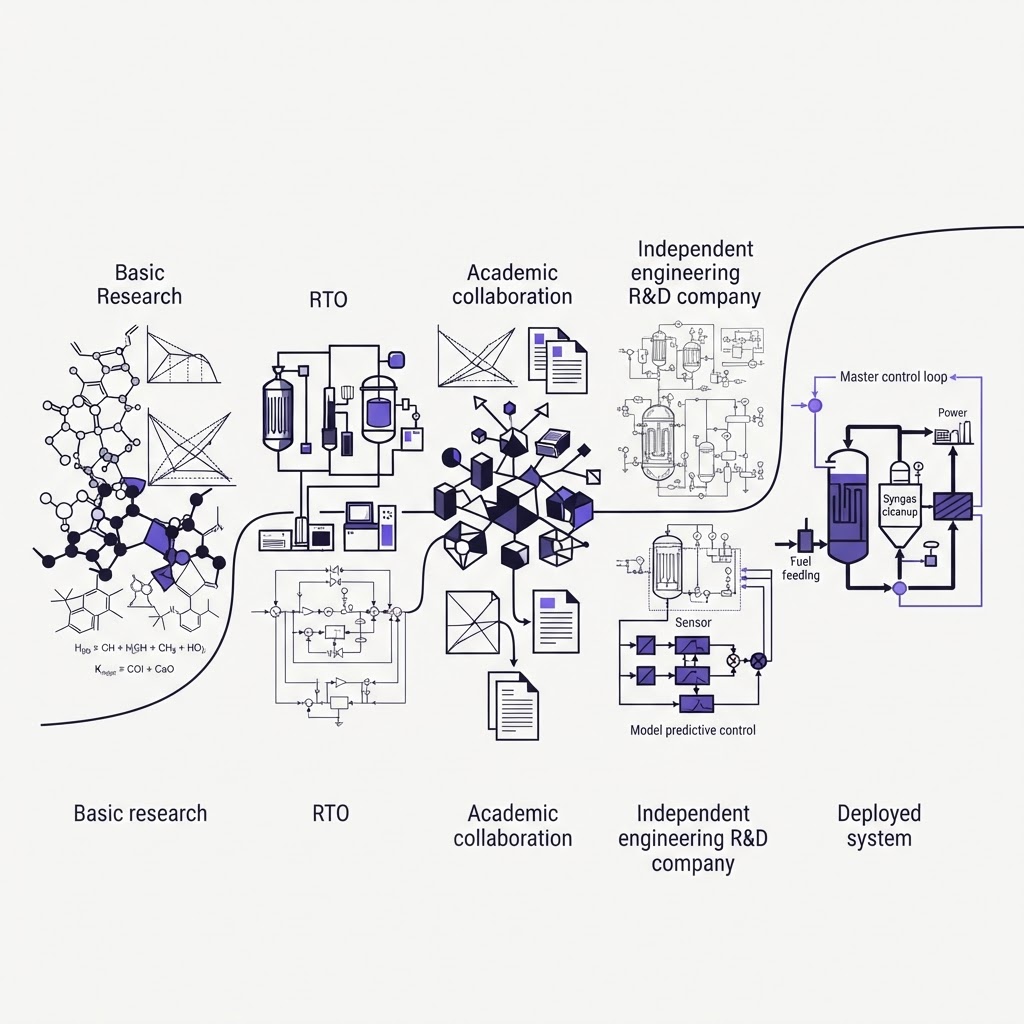
RTOs are the least known and often the best fit for industrial research. Fraunhofer in Germany, TNO in the Netherlands and VTT in Finland are the reference cases. The European association lists more than 97 RTOs in 24 countries, ranging from networks with a few thousand employees to specialised operations with no more than 100 people, and their stated role is bridging basic research and the market.
The same benchmark describes three project types that explain how an RTO behaves as a contractor: competence building paid from core public funding, applied research on mixed public and client money, and short application projects paid entirely by clients. Your contract sits inside that mix. The RTO also keeps its own agenda. Fraunhofer IGB states that besides contract research it carries out its own independent pre-competitive research, whose inventions companies can then license. That is a strength when the institute is already ahead of you in your field, and a point to settle in the IP clause when it is not.
3. University research groups
Universities perform contract research, but a research group's currency is publication and trained students. Expect deep method, slower cadence, and IP and publication terms negotiated through a technology transfer office. The best university engagements are ones where your problem is also a good paper. Where it is not, the incentives drift.
4. Independent engineering R&D companies
Private companies whose registered business is research itself. They have no core public funding, so the contract is the whole business model, and no publication clock, so the deliverable is whatever the contract says it is.
Equation Labs is one of these, and a worked example of what the type looks like on paper. It is registered in Las Palmas de Gran Canaria, Spain, incorporated 1 May 2025, with its registered activity CNAE 7210, experimental research and development in natural sciences and engineering, and it is listed with 1 to 10 employees. Small is normal for this type. What compensates for size is the institutional network: our research partners are Monash University, Fraunhofer Institute IKTS, Hochschule Zittau-Goerlitz and Robert Boyle Institut, all listed on our site alongside the programmes below. An independent organisation is only as credible as the counterparties you can independently check.
5. Companies whose in-house R&D also takes contracts
Some product companies rent out their R&D department. You get people who have shipped, and a structural conflict. A partner running its own internal projects in your field has a standing reason to keep the best ideas, whatever the contract says. This type is not disqualified by that. It just needs the tightest IP and field-of-use terms of the five.
How the organisation type changes what you receive
Four structural variables do most of the work.
Funding model. Who pays the organisation when you are not? An RTO with core funding can absorb exploratory work; a university can fold your problem into a funded doctorate; an independent company cannot subsidise you, which makes its scope and phase accounting stricter, and in research that is usually an advantage.
Own agenda. RTOs and universities pursue research beyond your contract. Independent firms pursue the next contract. In-house arms pursue their product. Know which one you are hiring, because it predicts where the best people's attention goes in month six.
IP posture. Pre-competitive research licensed out, publication rights, background IP from a parent product: each type brings a default. Commissioned work should state assignment explicitly, including for results that arise from the organisation's background IP.
Documentation standard. Research only counts as R&D if it is transferable or reproducible under the Frascati criteria. Organisations whose revenue depends on repeat contracts tend to treat the transfer package as the deliverable. Organisations whose currency is papers tend to treat the paper as the deliverable. Both are documents; only one is written for your engineers.
Matching the organisation to the problem
| Your problem | Usually the best fit | Why |
|---|---|---|
| A molecule, a trial, a GMP batch | Pharma CRO or CDMO | Regulated apparatus already built |
| Exploratory science with no product yet | University group | Method depth, long horizon |
| Scale-up, pilot plant, materials or process engineering | RTO | Infrastructure and industrial project experience |
| A model or controller that must run on a live process | Independent engineering R&D company | Scope, validation and deployment in one contract |
| An extension of a proven product | In-house R&D arm | Shipped experience, if IP terms hold |
The fourth row is ours, so read it with that in mind, but the reason is structural. When the output of the research acts on a running physical or biological system, the contract has to include deployment and safety evidence, which is where university and RTO scopes typically stop. Our two delivered programmes illustrate the scope. OptiVX, as primary R&D partner to Gemino, ran work package AP1 across 29 accounted work phases, with 400 simulated years certified and a +31% yield increase. IntelliBot, for MindWaves AI Solutions GmbH, ran work package AP3 predictive validation and closed with 400+ pages of transfer documentation. On the control stack, the safety layer runs under 2 ms and end-to-end edge latency fell from 1.2 s to 285 ms. Where a project sits on the line between research and delivery is its own question, covered in the difference between R&D and engineering.
Hybrid set-ups are common and often best. An independent firm leading the programme with an RTO or university as a named subcontractor gives you one accountable party plus institutional depth. That is how our programmes use our partner institutes.
Seat and legal form matter for funding
The organisation's type and location also change your cost after relief. Under the German research allowance, 70 percent of the contractor fee is the eligible basis, only the client may claim it, and the contractor must be seated in the European Economic Area. Fraunhofer notes the same client-side benefit in its cooperation terms. An excellent contractor in the USA, India or the UK therefore costs a German client more than an equivalent one in Spain. Equation Labs' research work is eligible under the FZulG, and the OptiVX IP patent was filed in July 2026. The mechanics and traps are covered in the German research allowance for contract research.
FAQ
Is a contract research organization the same as a clinical research organization?
No, though both use the acronym CRO. A clinical research organization runs trials. A contract research organization offers research services on contract more broadly, in pharma from preclinical testing onwards and elsewhere in any discipline. When a provider calls itself a CRO, ask which one it means.
What is an RTO and how is it different from a university?
A research and technology organisation exists to carry research into industrial use. It performs applied and contract research, funded by a mix of core public money and client contracts, and usually operates pilot facilities. A university's primary outputs are publications and graduates, so contract work fits around those.
Who owns the IP from contract research?
Whatever the contract says, which is why the default of each organisation type matters. RTOs may license results of their own pre-competitive research rather than assign them; universities usually protect publication rights; in-house R&D arms bring background IP from their product. State assignment, background IP and field of use in the contract before work starts.
Can a small company be a contract research and development organization?
Yes. Even among RTOs, some members are specialised operations with fewer than 100 staff, and independent R&D companies are frequently far smaller. Judge a small organisation by its registered activity, its delivered programmes and institutional partners you can verify, not by headcount.