
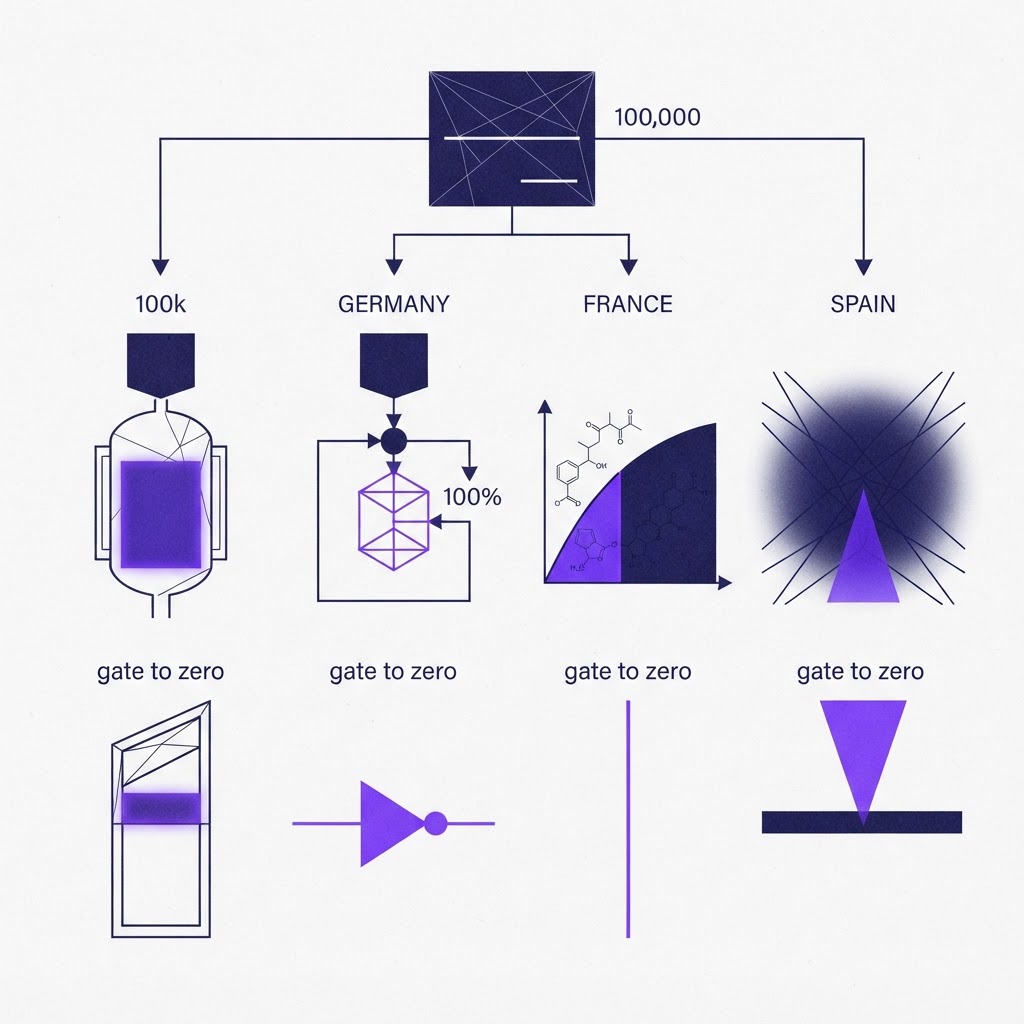
Most answers to "how does the contract research R&D credit work" stop at one number: 65 percent, the US rule. That number is correct for a US taxpayer buying research from a US contractor. It is the wrong starting point for everyone else. Send the same invoice to a German, French or Spanish tax office and it is recognised at 70 percent, at the full amount under a cap, or at the full amount on a condition about where the work happened. Each regime also has a gate that sets the credit to zero before anyone asks whether the work was good research.
We write this from the contractor's side. Equation Labs is an applied research company seated in Spain that delivers contract R&D programmes for clients elsewhere in Europe. The question we get asked before signature is rarely about the science. It is "will my credit recognise what I pay you?" The honest answer depends on where the client files taxes, and sometimes the answer is no.
Four regimes, four answers
| Regime | Share of the fee recognised | Gate that sets it to zero | Who claims |
|---|---|---|---|
| US, section 41 | 65 percent (75 or 100 in named cases) | Research conducted outside the US | The client, if it bears the risk and has rights to the results |
| Germany, FZulG | 70 percent | Contractor outside the EU or EEA | The client only |
| France, CIR | The amount paid, within caps | Provider not approved by the research ministry | The client; the provider only where the client cannot |
| Spain, Art. 35 LIS | The amount paid | Work performed outside Spain, the EU or the EEA | One entity only, normally the commissioning one |
The sections below take each row in turn, then the one rule all four share.
United States: 65 percent, and the research must happen in the US
The statute defines contract research expenses as 65 percent of any amount paid to a person other than an employee for qualified research. The credit itself is 20 percent of qualified research expenses above a base amount, so the 65 percent haircut applies before the credit rate, not instead of it.
The IRS audit guide adds a distinction that matters when you draft the contract. In a fixed-price research contract the entire amount is subject to the 65 percent limitation, while in a service contract paid by the hour with no research specified, only the amounts paid for qualified research work count. A contract that names the research is easier to defend than a time-and-materials engagement you have to reconstruct later. If you are unsure where your programme sits, the test is the line between R&D and engineering.
Where 75 and 100 percent apply
The same section raises the fraction in two places. Amounts paid to a qualified research consortium, a tax-exempt organisation run mainly to conduct scientific research on behalf of the taxpayer and at least one unrelated taxpayer, count at 75 percent. Amounts paid to an eligible small business, a university or a federal laboratory count at 100 percent, but only where the qualified research is energy research.
Three conditions on the contract
The regulation sets out when a payment counts as paying for research rather than buying a product. The agreement must be entered into before the research is performed, must provide that the research is done on behalf of the taxpayer, and must require the taxpayer to bear the expense even if the research fails; the portion of any payment that is contingent on success is not a contract research expense. "On behalf of" means the taxpayer has a right to the results, and that right does not need to be exclusive. The worked examples in the same regulation show the mechanics: of a 300x payment, 195x counts, and where 100x of it was a success bonus, only 65 percent of the remaining 200x counts.
The foreign research exclusion
This is where the US row usually ends for a European contractor. Section 41 excludes research conducted outside the United States, Puerto Rico and US possessions from qualified research altogether. It also excludes research to the extent it is funded by another person, which is why a US contractor cannot claim the credit on work its client pays for.
So we say it plainly: a US company commissioning research that we perform in Spain gets no section 41 credit on that fee. If the credit drives the decision, a US-based partner is the right call. If the research is the reason, the credit is not.
Germany: 70 percent, an EEA contractor, and the client claims
Under the Forschungszulagengesetz, 70 percent of the fee counts for projects commissioned after 27 March 2024, 60 percent for earlier ones, and the allowance is 25 percent of the basis with 10 more points for SMEs. Two conditions decide whether that 70 percent exists at all. Only the client may claim, and a contractor abroad qualifies only if it is based in an EU member state or an EEA state that provides the mutual assistance needed to check eligibility.
That is the regime we work under most often. Equation Labs S.L. is registered in Las Palmas de Gran Canaria, Spain, inside the EEA, and IntelliBot, one of our two delivered programmes, was run for a German GmbH. The full German mechanics, including the date of award, sub-contracting and the BSFZ work plan, are in our guide to the German research allowance on contract research.
France: the full amount, but only through an approved provider
The French crédit d'impôt recherche works differently. There is no fixed fraction applied to the fee. Instead, the CIR rate is 30 percent of research expenditure up to 100 million euros and 5 percent above that, and eligible expenditure includes research operations entrusted to public research bodies or to private research organisations approved by the research ministry.
The approval is the gate. If the provider does not hold the approval, expenditure on operations it carries out is not taken into account in the client's CIR; approval is normally granted for three years. A French client should ask for the approval before scoping starts, not after the invoice arrives, and should check that it covers the contract date.
Two caps on outsourced research
Two limits apply, and the lower one wins. Outsourced research counts only up to three times the client's other eligible research spend, and in any case up to 2 million euros a year where client and provider are dependent, or 10 million euros otherwise. The official worked example: a company with 800,000 euros of in-house research can count at most 2.4 million euros of outsourced work. A company with no in-house research effort therefore gets little from outsourcing alone.
Spain: amounts paid count if the work is done in the EU or EEA
Spain treats contract research as research expenditure of the client. Amounts paid for R&D carried out in Spain or any EU or EEA member state on behalf of the taxpayer count as R&D expenses; the deduction is 25 percent of the period's spend, 42 percent on the excess over the average of the previous two years, plus 17 percent on the cost of qualified researchers dedicated exclusively to R&D.
The rule every regime shares: one claimant
Four codes, one principle: the same research is credited once. The US gives it to the party that bears the risk and has rights to the results. Germany gives it to the client, full stop. Spain gives it to the commissioning entity, with the performer as fallback. France has the most detailed version. An approved provider must deduct what it receives from its own CIR base; it may claim the work itself where the client cannot benefit, for example a foreign company, but not where an eligible client simply chooses not to claim, and a provider without approval may include research done for third parties in its own base.
In practice this belongs in the contract as a written line: the contractor states that it will not claim the commissioned work as its own research. It costs nothing to write and removes the most common audit question.
Choosing a partner across borders
Put the table to work in the order that saves the most money:
- Where do you file? That picks the regime, and therefore the gate.
- Does the contractor pass the gate? Location for the US, Germany and Spain; ministry approval for France. A failed gate means zero credit, however good the research is.
- Is it research? Routine integration, testing and consulting fail in every regime. Start with what contract research is if the scope is still loose.
- Do you bear the risk and hold the results? In the US, success-contingent fees and missing rights to the results take money straight out of the claim.
- Can the invoice be read? Split R&D and non-R&D lines, so the recognised share is not argued item by item.
The last point is where a contractor either helps or hurts. OptiVX ran as work package AP1 across 29 accounted work phases with 400 simulated years certified, and IntelliBot ran as work package AP3 across 4 workstreams, closing with more than 400 pages of transfer documentation. We did not cut the work that finely for tax reasons. We did it because the controllers act on live processes and have to be validated. The same granularity lets a work plan, an invoice and a credit claim agree, in any of the four regimes. For the commercial side of choosing a partner, see buying contract research and development services.
FAQ
Can a US company claim the R&D credit for research done by a contractor in Europe?
No. Section 41 excludes research conducted outside the United States, Puerto Rico and US possessions, so a fee paid for research performed in Spain, Germany or France is not a qualified research expense for a US taxpayer, whatever the contract says.
Does a success fee count as a contract research expense in the US?
Only the part of the payment the client owes regardless of outcome counts. The portion contingent on the research succeeding is treated as buying a result, not paying for research, and drops out before the 65 percent is applied.
What happens if a French client uses a provider without CIR approval?
The client cannot include that spend in its CIR. The unapproved provider can instead include its own eligible research costs for the work in its own base.
Can a Spanish contractor claim the deduction when the client is abroad?
Yes. When the commissioning entity is resident abroad and cannot apply the Spanish deduction, the Spanish entity performing the R&D may apply it, because only one entity may take the deduction for the same work.