
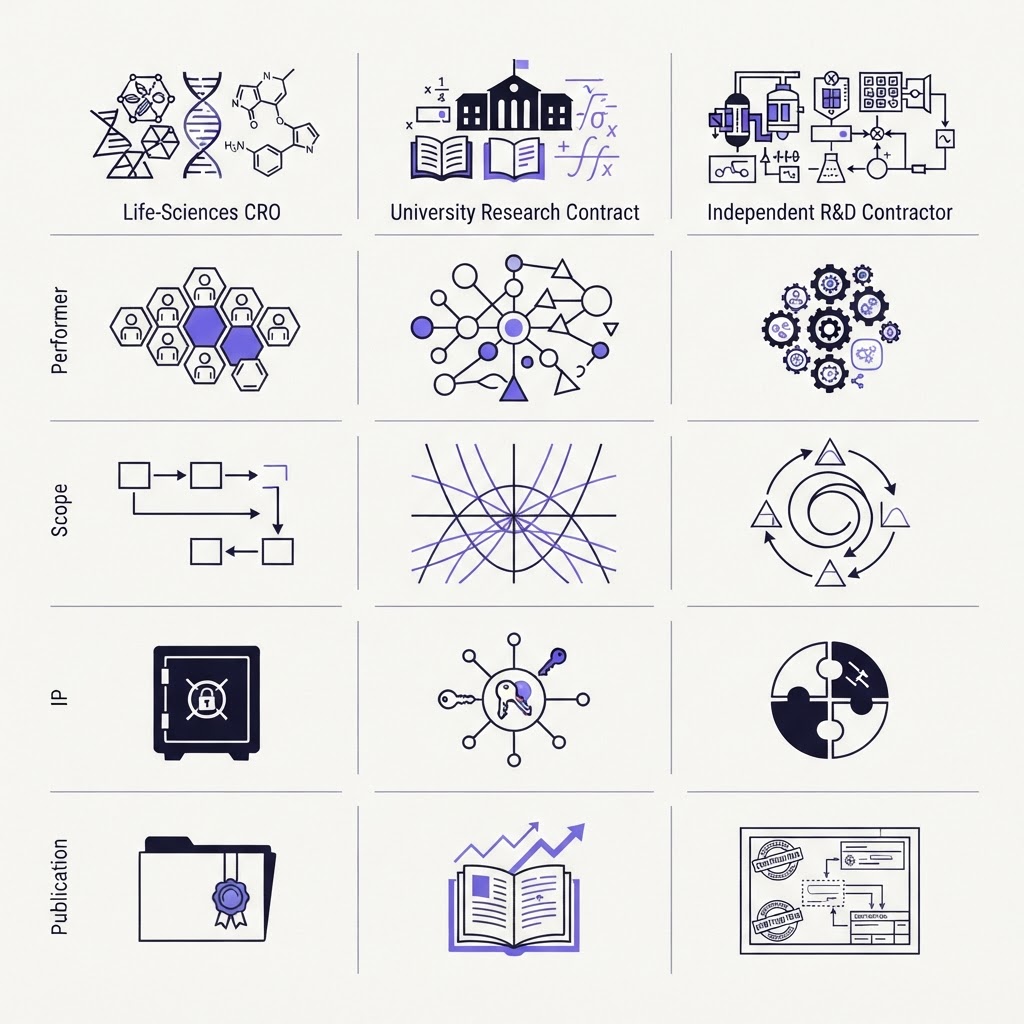
Ask what contract research is and the answer depends on who you ask. A clinical operations lead means a company running part of a drug trial. A university research office means a signed agreement with an outside sponsor. An engineering director means hiring a specialist team to solve a technical problem the company cannot solve in house. All three are correct, and a reader who takes the wrong one into a negotiation will sign the wrong kind of contract.
This page puts the three meanings side by side, gives the one test that holds for all of them, and shows how to tell which one is on the table.
Contract research, defined once for every industry
The cleanest general definition comes from an Industry Canada study of the sector: contract research is the activity by which a client hires the services of an external organization to carry out a specific piece of R&D. Two words in that sentence carry the weight. Client means someone pays and someone performs. Specific means the question is defined before the work starts, rather than left to the researcher's curiosity.
That gives a single test that works in every industry. Contract research is research where a paying client defines the question, and a written contract, not custom or academic norm, decides who owns the answer and who may publish it. The three meanings below differ in who the performer is and which rules sit underneath the contract. They do not differ on that test.
Meaning one: the contract research organization in life sciences
Most of the first page of results for this query is about CROs, because in everyday use the acronym belongs to pharmaceuticals. In the life sciences, a CRO is a company that supports the pharmaceutical, biotechnology and medical device industries with research services outsourced on a contract basis, from assay development to clinical trial management and pharmacovigilance.
Duties are transferred in writing, accountability is not
The regulatory framing is precise. Under ICH E6(R2) section 5.2 and, for FDA-regulated trials, 21 CFR 312.52, a sponsor may transfer any or all trial-related duties to a CRO, but ultimate responsibility for data quality and integrity always stays with the sponsor. A partial transfer must itemise which obligations move, and anything not transferred in writing remains with the sponsor by default. A company is "the CRO" only for the duties a written agreement actually hands it.
Full-service or functional service provider
The same entry distinguishes two engagement models. A full-service CRO takes end-to-end operational responsibility under its own systems and procedures. A functional service provider covers discrete functions, such as monitoring or biostatistics, while the sponsor keeps day-to-day integration in house. It also notes the edge case: a university's internal clinical trials office is not a CRO, but some academic medical centres run an academic research organization that contracts CRO-like services to outside sponsors.
If your question involves patients, an investigational product or a regulator reviewing trial data, this is the meaning you need, and the rules are largely set for you.
Meaning two: contract research at a university
Outside clinical trials, universities use "contract research" for any agreement in which an external party pays the institution to investigate a defined question.
What a university research contract contains
A typical definition, from the University of Prince Edward Island, describes a written legal agreement between the university and a sponsoring external party that usually specifies deliverables, a schedule with progress and final reports, payment terms, ownership of resulting intellectual property, publication and disclosure, and warranties and indemnity. Indirect costs must be included in the budget, and the contract is with the university, never in the name of an individual researcher or department.
The same page separates it from its neighbours. Collaborative research agreements cover work of mutual interest where results may be shared. Research service contracts cover routine analytical or testing work requiring little original intellectual input, where IP usually stays with the sponsor.
Contract, collaboration, service or grant
Two clauses cause most of the friction. The first is publication. In a sponsored research agreement the standard resolution is a confidentiality review period of commonly 30 to 60 days, plus a further period of commonly 30 to 90 days if the sponsor needs to file a patent, with most university policies capping total delay and prohibiting an outright sponsor veto. The second is foreground IP, the most heavily negotiated clause: sponsors typically want assignment or an exclusive option, universities prefer to keep ownership and grant a licence.
The reason these clauses must be negotiated at all is structural. Federally funded research in the US sits inside the Bayh-Dole framework, but industry-funded work has no statutory answer to who owns what comes out of it, so the contract has to supply one. For a recurring relationship, the same guide describes a master research agreement with short work orders, which generally makes sense once a sponsor reaches roughly three or four discrete projects a year.
What distinguishes a contract from a grant is who defines the approach. In a grant the investigator defines it and works on a best-efforts basis toward a described aim; in a contract the funder defines it through a statement of work with deliverables, milestones and acceptance criteria. If you are writing the statement of work, you are commissioning contract research, even when the performer is a professor.
Meaning three: the independent R&D contractor
The third meaning is the one the glossaries skip: a company whose business is performing defined R&D for clients in engineering, materials, software or control systems. The client negotiates with a company rather than an institution, so ownership and publication are whatever the two parties agree.
Equation Labs is this kind of organization. Its registered activity is CNAE 7210, experimental research and development in natural sciences and engineering. Our two delivered contract programmes show what the arrangement looks like in practice. OptiVX ran as work package AP1, Core AI and ML models, for Gemino, across 29 accounted work phases, with 400 simulated years certified and a measured +31% yield increase. IntelliBot ran as work package AP3, Predictive validation, for MindWaves AI Solutions GmbH, across 4 workstreams.
Notice what those descriptions lead with: a work package number, a count of accounted phases, a certified validation volume. In this meaning of contract research, the record is the product. We have written separately about how a contract R&D programme is structured, including the background and foreground IP split and the transfer package, and about buying contract research and development services when the deliverable is a controller rather than a molecule.
How to tell which kind of contract research you are looking at
The first two columns summarise the sources cited above. The third describes how our own programmes are contracted.
| Question | Life-sciences CRO | University research contract | Independent R&D contractor |
|---|---|---|---|
| Who is the performer | A legally distinct company engaged by a trial sponsor | The institution, signed by an official with contracting authority | A commercial company whose registered activity is R&D |
| Who defines the scope | The sponsor, duty by duty in writing | The sponsor, through a statement of work | The client, through work packages |
| Who owns the results | Set by the agreement; data accountability stays with the sponsor | Negotiated; universities often keep ownership and license | Negotiated in the contract |
| Publication | Governed by the sponsor's trial obligations | University right to publish, sponsor may delay but not veto | Set by the contract |
| Rules underneath | ICH E6(R2), 21 CFR 312.52 | Institutional policy; no statutory IP default for industry funding | The contract, plus any funding or tax regime the client relies on |
A short decision guide follows from the table:
- Is there a clinical trial or a regulatory submission of trial data? You need a CRO, and the regulations will shape most of the agreement.
- Do you want the answer published, or a research group's standing in the field attached to it? A university contract fits, provided you agree the publication window and the foreground IP clause before work starts.
- Do you need a deployable result, confidentiality and a team that answers to milestones? An independent contractor fits, and your first question should be what the handover record will contain.
Whichever you choose, check the funding side early. In Germany, for example, the rules on the German research allowance for contract research decide which party may claim relief and where the contractor must be seated. Outside pharma, a company offering the third kind of work is often described as a contract research and development organization.
FAQ
Is a contract research organization the same thing as contract research?
No. CRO is the life-sciences name for a company a trial sponsor contracts to take on named trial duties. Contract research is the wider arrangement, and it also covers universities doing sponsored work and engineering companies performing R&D for clients.
Can a company stop a university from publishing contract research results?
Usually it can delay publication, not prevent it. Standard terms give the sponsor a review window to remove its confidential information and time to file a patent, while most university policies cap the total delay and rule out a veto over the scientific conclusions.
Who signs a contract research agreement at a university?
An institutional official with contracting authority, such as the research contracts or sponsored programs office. The principal investigator leads the scope discussion, but the agreement binds the institution, not the individual researcher.