
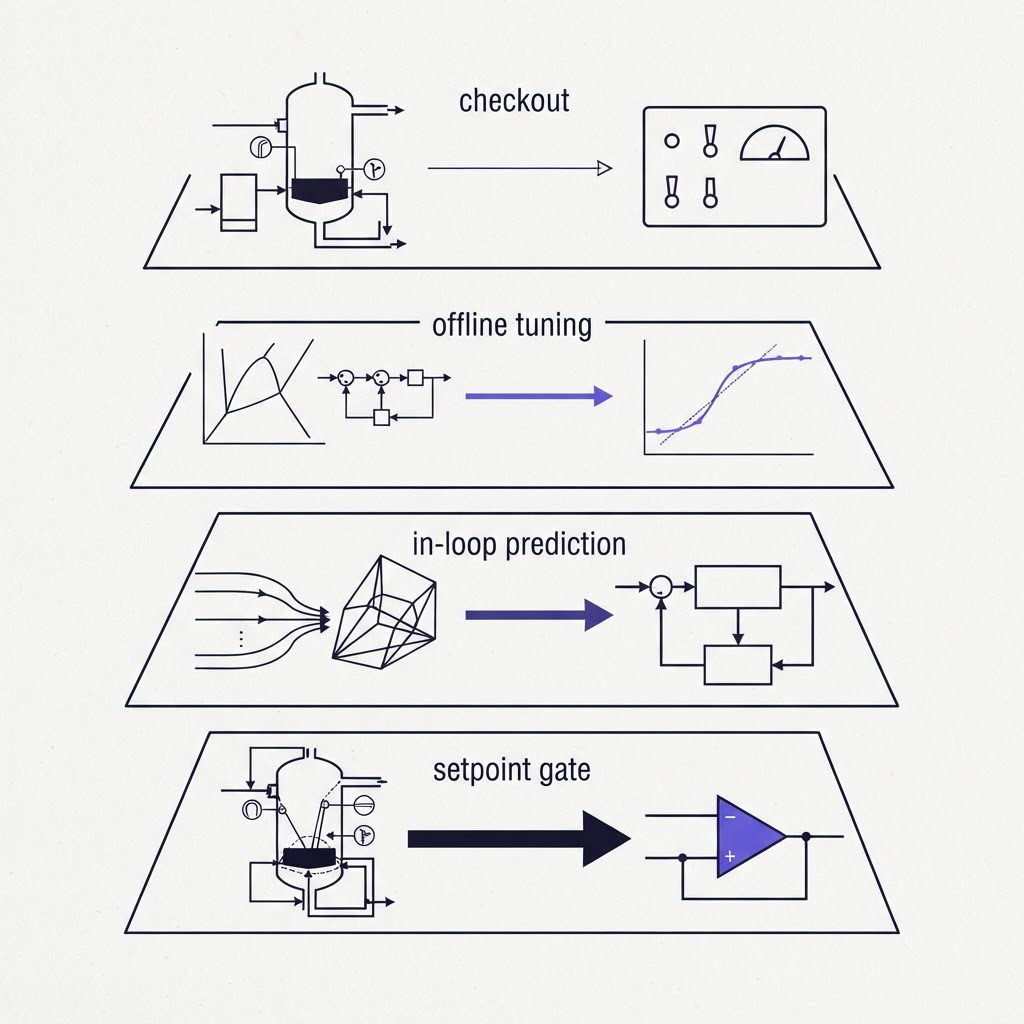
A digital twin for process control is sold as one thing and used as four. The same dynamic model can check PLC code before start-up, tune a loop without touching the plant, predict inside a model predictive controller, or decide whether a proposed setpoint is allowed to reach the regulatory layer at all. Each of those jobs hands the twin more authority, and each needs a better twin.
Vendor pages describe the lifecycle. Research papers each prove one use. What neither tells a control engineer is the thing they actually need to know: how good does the twin have to be before its verdict on a controller counts? That is the question this article answers, job by job, with the evidence the published work gives and the thresholds we hold ourselves to.
What a digital twin for process control actually is
A process simulator and a digital twin overlap, but they are not the same object. Emerson's whitepaper sets out the best practice requirements plainly: the process model must be first principles (fluid dynamics, kinetics, thermodynamics), dynamic and real time, and the control system simulator attached to it must run the exact application software of the plant, without additions or deletions. All plant I/O is simulated, even where the signal comes from a simplified model.
The ISA chapter on the twin makes the same point from the practitioner side: the configuration, operator interface and alarm system are the ones used in the lab, pilot plant or production plant, connected to a first principles model through simulated or virtual I/O. The value comes from that identity. A test on the twin is a test of the real control code against a model of the real process.
So for our purposes a digital twin for process control is three things together: a dynamic process model, the unmodified control configuration, and a feed of plant data that keeps the model honest over time. Drop the third and you have a simulator. Drop the second and you have a model.
Four jobs, four levels of authority
The useful way to sort twin applications is not by industry or software vendor. It is by what the twin is allowed to decide.
Checkout and virtual commissioning
The lowest authority job: the twin plays the plant so the control code can be exercised before the plant exists. A 2025 PLOS One study written for control engineers as twin users, rather than twin builders, lays out the workflow: assess twin maturity, choose a physical or virtual controller, build a virtual commissioning platform with bidirectional real time communication, then iterate while injecting disturbances and fault scenarios. Emerson places the same job in factory acceptance testing, where loops are initially tuned to support smooth start-ups.
The twin here finds errors in the code. It does not tell you the code is good.
Tuning loops offline
One step up, the twin stands in for plant experiments. Guided Bayesian optimization, published on arXiv, builds a simple twin from closed-loop data collected during normal tuning and uses it to answer questions instead of the hardware. On two real motor systems it needed 57% and 46% fewer hardware experiments than plain Bayesian optimization to find the optimal controller parameters.
A related 2026 preprint goes further and has a language model generate the whole tuning environment from a dynamic process model. On a gas preheater benchmark, Bayesian optimization then reduced the closed-loop objective by about 26.5% against the initial generated controller. The authors are careful to say that figure measures the tuning stage, not a comparison with a manually designed controller.
Prediction inside the control loop
Now the twin is part of the controller. A 2026 study on a phosphoric acid purification process ran MPC over a twin with a neural network correction branch and a genetic algorithm searching the control moves. Against baseline MPC it reported 95.1% purification against 91.2%, an 11.4% lower integral tracking error and 10 to 15% smaller control signal amplitude.
At this level a twin error is no longer a failed test. It is a wrong control move.
Gatekeeping supervisory setpoints
The highest authority job is the newest. A July 2026 preprint lets an open weight language model propose distillation column setpoints every five minutes, but puts a forked-twin counterfactual gate between proposal and execution: a 30 minute horizon, a 5 minute fast fail and nine pinned constraints. Every admit or block names a constraint and a margin, and can be reproduced from the twin.
The results are the argument for the gate. Ungated, the agent beat Pareto-tuned linear MPC at off-nominal target acquisition and lost badly at disturbance rejection, with an IAE ratio of 10.18 at the point estimate. Across a 250-cell pass the gate still corrected 318 actively harmful proposals. Here the twin is the safety case. If it is wrong, the gate admits the wrong move with a clean audit log.
How good the twin has to be for each job
The published material agrees on one principle and gives surprisingly few numbers. The principle, stated in the Emerson paper, is that different uses need different fidelity: accurate motor, valve and instrument models for interlock and regulatory control tests; mass and heat balances for batch sequences; reaction kinetics, advanced thermodynamics and hydraulics for real operational improvement. The PLOS One workflow turns that into a gate of its own, a maturity evaluation that decides whether a twin is fit for control system design before any design starts.
What converts the principle into a test is error measured against the plant, under a rule set before you look. The guided Bayesian optimization paper is the clearest example we found. The twin is only consulted when its RMSE stays under a threshold set at three times the measured noise standard deviation, estimated from five repeated experiments at identical gains. When measured and predicted cost diverge, the twin's data set is discarded and rebuilt. The twin earns authority one comparison at a time and loses it automatically.
Mapped to the four jobs, our working bar looks like this:
| Job | What the twin must reproduce | Evidence of fitness |
|---|---|---|
| Checkout | I/O behaviour, sequences, interlocks | Same control configuration, all I/O simulated |
| Offline tuning | Closed-loop dynamics near the operating point | Error under a noise-based threshold, rechecked on the plant |
| In-loop prediction | Dynamics across the operating envelope, including disturbances | Held-out prediction accuracy on plant data, not training fit |
| Setpoint gate | Constraint behaviour at the edges, where the plant is least visited | Counterfactual tests at the limits, logged and reproducible |
The ISA chapter adds the warning that belongs next to the last two rows: neural networks interpolate well and extrapolate badly, so check whether the inputs are inside the training range before trusting a learned correction. A twin tuned on normal operation is weakest exactly where a safety gate needs it most. That is also why we fit plant dynamics with neural differential equations rather than discrete-step black boxes when the model has to survive outside the data it was fitted on.
The trap: results measured on the twin
Read the purification study closely. The authors state that all control experiments were carried out in the twin environment, with the nonlinear physico-chemical model serving as the virtual plant. The PLC architecture is the intended implementation. That is honest, and it is also common: the headline improvement is a twin's opinion of a controller, measured by the same twin.
Nothing is wrong with that as research. It becomes a problem when a result like it is quoted as plant performance, because it has skipped the one step that makes a twin trustworthy, the comparison against measurement. Before you accept a vendor or research claim about a digital twin for process control, ask one question: was the improvement measured on the plant, or on the model? If the answer is the model, the next question is how the model's error against the plant was measured, and on which operating data. The size of the gap between simulation and plant is the only number that tells you how much of the result will survive.
What we require before a twin certifies a controller
Our contract R&D work sits at the top two levels of that table: learned controllers for living and thermochemical processes, where the twin predicts inside the loop and is the evidence the controller is safe. The figures we publish are the ones we measured, on our own programmes: a growth model with R-squared above 0.95, a safety layer that answers in under 2 ms, end-to-end edge latency of 285 ms reduced from 1.2 s, and zero safety violations across 400 simulated years, validated on a 500 L pilot basin.
Four rules sit behind those numbers.
- Fit is measured on held-out plant data. A twin that only matches the data it was trained on has proven nothing about the controller.
- Simulated years are not a substitute for the pilot. The 400 years stress the controller across conditions a basin would take decades to produce. The 500 L pilot checks that the twin was right about the conditions it can produce.
- Safety does not live inside the model. We keep a safety filter that sits outside the model, so a twin error costs performance before it costs a constraint.
- Authority is granted in stages. The ISA practice is the right one: after validation, systems first run in monitoring mode, and when process inputs are finally manipulated they are restricted to a very narrow range. We treat the twin's verdict the same way.
None of this is exotic. It is the discipline of stating, before the test, what the twin must reproduce and how its error against the plant will be measured, then refusing to promote the controller until that number is in. For the broader buyer's version of the same argument, see what must be true before AI moves an actuator.
FAQ
What is the difference between a digital twin and a process simulator?
A simulator models the process. A digital twin for process control couples that dynamic model to the exact, unmodified control configuration of the plant and keeps it current with plant data, so it can be used from engineering through operations.
Can a digital twin replace physical commissioning?
It shortens it rather than replacing it. In life sciences, twin-based offline testing is accepted in parts of installation and operational qualification, and Emerson reports it can reduce field qualification requirements and start-up time. Field checks still happen.
How do you keep a digital twin accurate as the plant changes?
Adapt it against the running plant without letting it act: the ISA approach connects the twin read-only, takes modes and setpoints from the plant, and adjusts model parameters until its outputs track plant measurements. Treat any large divergence as a signal to refit.
Can a language model use a digital twin to write setpoints?
Only behind a gate. In the distillation benchmark above, an ungated agent was far worse than linear MPC at rejecting disturbances; a twin-based counterfactual gate with pinned constraints contained it and logged every intervention.