
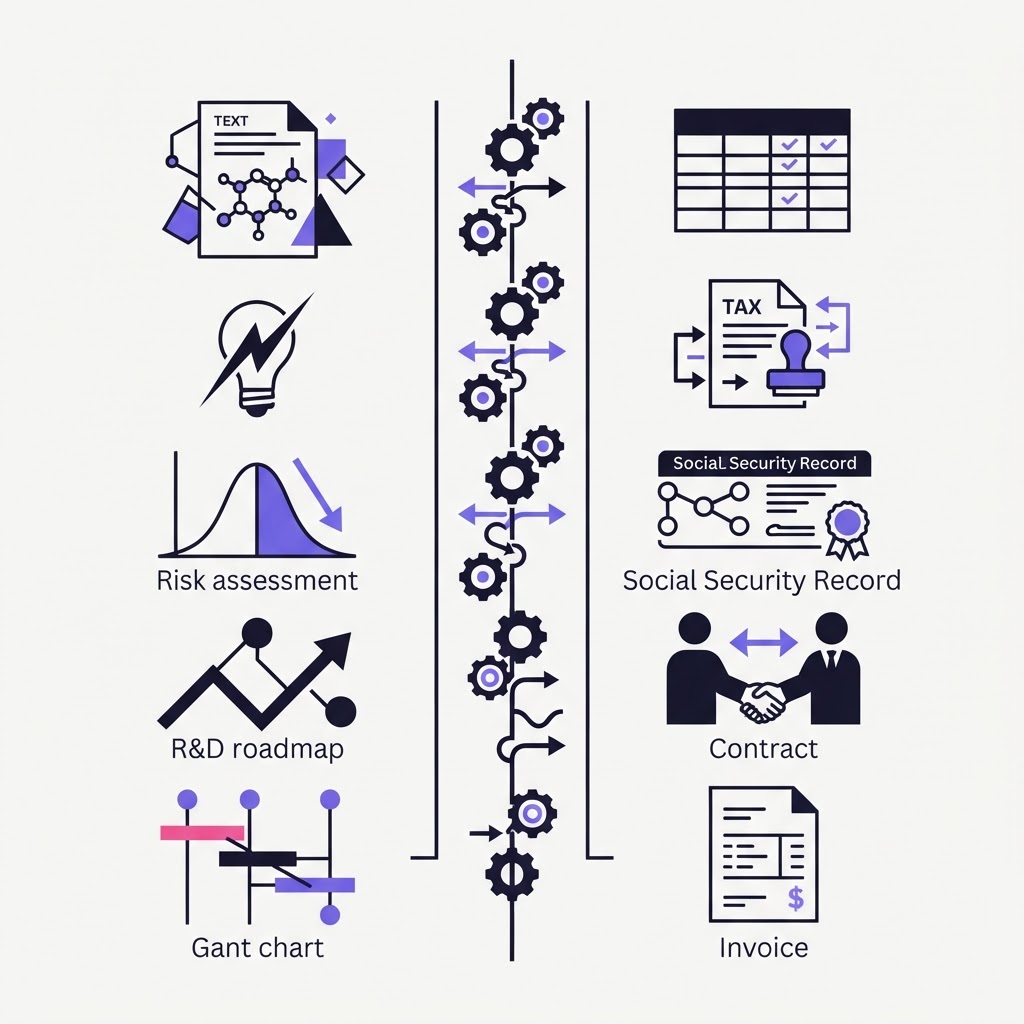
Forschungszulage Dokumentation is not one file. It is two records written for two readers who never talk to each other. The Bescheinigungsstelle Forschungszulage (BSFZ) reads a project description and decides whether the work is research. The Finanzamt reads hours, payroll and invoices and decides what the research cost, sometimes years later, in a tax audit. A claim fails when either record is missing, and it fails quietly when the two records describe different projects.
This article sets out what each reader asks for, quoting the statute, the BSFZ's own review guide and the Federal Ministry of Finance (BMF) timesheet template rather than a consultancy summary. It is written from the contractor's side. Equation Labs delivers contract research to German clients, and the client's claim stands or falls partly on what the contractor writes down. The arithmetic of that claim is covered in research allowance on contract research in 2026. Here the subject is the record.
Two readers, two records
The Forschungszulage has no reporting cycle. Unlike classic project funding there are no interim or final reports to a project agency, but timely, complete documentation kept by the company itself is the condition for costs being recognised later; the BSFZ assesses the content, and the tax office then checks the claimed costs against the receipts, including in later audits.
The statute sets the standard both records must meet. The application must identify the research projects and the eligible expenditure precisely enough that verification is possible, a BSFZ certificate is required for every project listed, and the claimant must affirm that the facts on which the certificate was based have not changed. That last clause ties the two records together. If the hours and invoices describe work the certificate never covered, the affirmation is wrong.
The second record is read under tax law, not grant law. The allowance is set in an assessment that is procedurally equivalent to a tax assessment: it can be corrected only under the Fiscal Code, it is subject to the Betriebsprüfung, it can be appealed before the fiscal court, and equity relief is excluded by statute. No equity relief means no goodwill for a gap. The record either supports the number or it does not.
What the BSFZ reads: the project description
Novelty, risk and a plan, in the official form
The ordinance lists what the certification application contains. It must include a meaningful, comprehensible description of each project, whether it is in-house research, contract research or a cooperation, and the time, personnel and financial scope; the BSFZ may request additional documents and carry out on-site inspections, and the certificate should be issued within three months of complete documents.
The BSFZ's review guide (Prüfleitfaden, version 10/2025) explains how that description is judged. Projects are assessed on three criteria, novelty, risk and systematic approach; following the Frascati Manual, an R&D process must be systematic, run to a fixed plan and provide for documentation of both the individual steps and the results; risk counts only where the original solution may not work and an alternative or modified approach becomes necessary, and more test runs than planned is not enough; incomplete information triggers a written request for more (Nachforderung), but if one criterion is clearly unmet no request is made for the others; and the person-months and contract costs are checked for plausibility in principle.
Read that risk definition twice, because it decides what a good research log looks like. A log that records only progress proves a plan. A log that records the approach that failed, why it failed and what replaced it proves risk. In control research the second kind writes itself: a controller that held in simulation and broke on the live process, and the barrier function or retraining that followed, is exactly the evidence the criterion asks for.
The same guide is strict about form. The description has to be in the official form, not in a free annex, and it cannot point back to an earlier application; every project is described again in full.
German only, and which annexes count
This is the rule that catches foreign research partners. The guide states that German is the official language, so project descriptions, answers to a Nachforderung and objections must be in German, and annexes not written in German are excluded from the review. It also treats unstructured attachments such as dissertations, journal articles, applications from other funding programmes and product brochures as not assessable. What it does accept as annexes are technical sketches, images of test setups, prototypes or processes, and tabular work plans or Gantt charts.
The practical consequence: an English technical report, however thorough, does not certify anything. The German text in the form carries the certificate, and a work plan table or a diagram is the most useful annex a contractor can supply.
What to keep out of the work plan
The guide also lists activities that are never certified, for in-house and contract work alike: administrative and technical project management, patent searches and the legal work of obtaining patents, tests run only to generate data for approval, standardisation or certification, feasibility studies, market research, training, and everything after the test of a prototype. A work plan that bundles these into a research work package invites the BSFZ to cut the package. Better to leave them out of the R&D description entirely and keep their hours off the R&D timesheet.
What the Finanzamt reads: hours, payroll and invoices
The timesheet
The BMF publishes a model timesheet. Its footnotes are effectively the rules. The record stays with the claimant and can be produced as evidence; where an employee works on several projects a separate record is kept for each; the project name should match the short name on the BSFZ certificate; activities that serve the project only indirectly, such as management, administration or transport, are excluded; the record is confirmed by a project lead; and for a researching owner at most 40 hours per week are eligible.
The template is not mandatory. Any time recording is acceptable if it meets the GoBD standard, timely, complete, traceable and unalterable, and separates R&D hours from the rest; Jira reports, Git logs or time-tracking tools with automatic timestamps are equivalent, while spreadsheets built after the fact are problematic. The same source lists what sits next to the hours: per employee total and R&D hours per month, the annual Lohnsteuerbescheinigung for the gross wage, and social security records for the employer's share.
None of this goes in with the application. The Bavarian tax authority's guidance says receipts are not filed with the claim, that the tax office decides whether to request them, and that a company should therefore keep three things ready: the employees deployed with a short description of their R&D activity, the timesheets for employees and own work, and a short description of each project's status at the end of the fiscal year. That year-end status note is cheap to write in December and very expensive to reconstruct four years later.
Contract research: contract plus project-specific invoice
For the client who commissions research, the evidence is documentary rather than hourly. At the second stage the tax office checks whether the claimed contract research costs belong to the certified project; it expects the contract or order to name the R&D project and the subject of the research clearly, and the contractor's invoice to carry a project-related description of the work rather than a collective invoice. The procurement side of that contract, the seat test and the IP clause, is covered in what to demand in the contract research agreement, and which external costs count is a question of its own.
When the record fails
The consequence is financial first. Where documentation duties are not met or essential evidence is missing, allowances already granted can be reclaimed with interest, and in serious cases a suspicion of subsidy fraud can arise, with criminal consequences.
The failure modes are ordinary. Banhoek's list of frequent mistakes reads like a description of most first claims: time reconstructed at year end or at filing instead of recorded as the work happens, hours not assigned to a specific project when several run in parallel, project descriptions that list tasks without connecting them to plan, risk and novelty, and contract research or equipment receipts not assigned to a project.
A retroactive claim without timesheets is not automatically lost. Foerderscan's guidance is that R&D shares can be estimated afterwards from project plans, sprint documentation and Git commits, and that the more plausible the reconstruction, the better. It remains a reconstruction, read by an auditor who knows it is one. The timing rules for such claims are in the application sequence step by step.
The contractor's half of the record
Everything above is the client's file, but a contract research client cannot write the research part of it alone. The contractor carried the uncertainty, so the contractor holds the evidence that it existed. A partner that only implements a specification has not done what contract research is, and its paperwork will show that.
Equation Labs structures programmes so its paperwork maps onto the two records. OptiVX ran as work package AP1, Core AI and ML models, for Gemino across 29 accounted work phases with 400 simulated years certified, and IntelliBot ran as work package AP3, Predictive validation, for MindWaves AI Solutions GmbH across four workstreams, closing with more than 400 pages of transfer documentation. The mapping is direct:
- Work package = the BSFZ work plan. One named package per research question, so the client's German description and Gantt chart can cite it.
- Accounted phase = invoice line. Twenty-nine phases are twenty-nine project-specific line items, the opposite of a collective invoice.
- Transfer file = evidence of method and risk. It records which approaches were tried, which failed on the real process and what replaced them, which is the risk criterion in the BSFZ's own words.
- Seat on record. Equation Labs S.L. is registered in Las Palmas de Gran Canaria, Spain, inside the EEA.
One caveat, stated plainly because the review guide states it plainly: an English transfer file is evidence for the Finanzamt and for the client's own engineers, not an annex the BSFZ will read. The certificate rests on the German description in the official form. What the contractor can do is write the transfer file in the same structure as that description, with the same project short name, the same work packages and a tabular plan that translates without interpretation, so the German text and the technical record describe one project.
FAQ
Do I have to use the BMF timesheet template for the Forschungszulage?
No. The template is a recommendation. Any time recording works if it is kept as the work happens, is assigned to a specific project, and separates R&D hours from other work.
Do I submit the documentation with the Forschungszulage application?
No. Receipts and timesheets stay with the company. The tax office decides whether to request them, during the assessment or in a later audit.
Can the BSFZ application be written in English?
No. German is the official language. The project description, any answer to a Nachforderung and any objection must be in German, and annexes in other languages are excluded from the review.
Is a final report required for the Forschungszulage?
No interim or final report goes to a project agency. A short status note per project at each fiscal year end is still worth writing, because it is one of the things the tax office may ask for.
This article describes the statute, the BSFZ review guide and published official and professional guidance as of October 2026. It is not tax advice. The claim is filed by the client with its own adviser.