
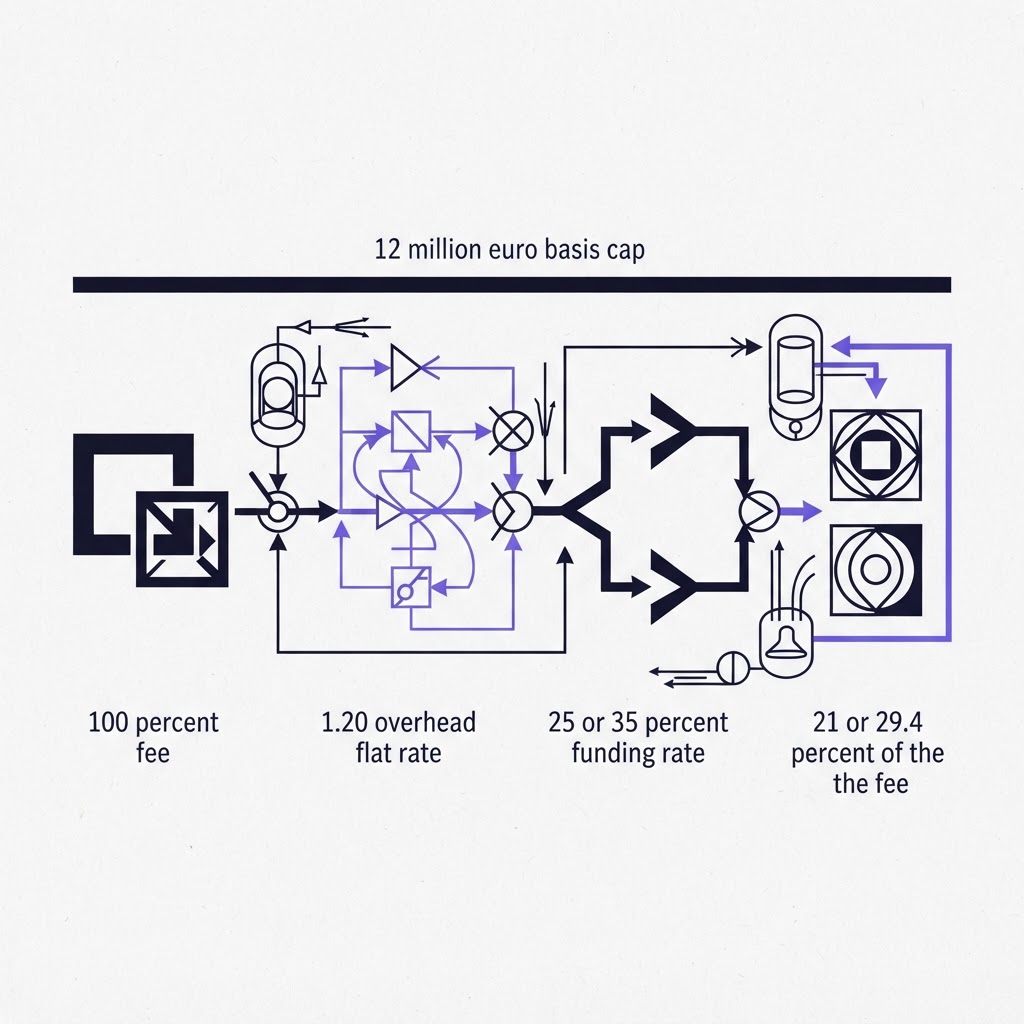
The research allowance Germany pays on contract research is not one number. It is a chain of four: the share of the fee that enters the basis, a flat rate stacked on top of that share, the funding rate applied to the result, and a ceiling that caps the whole thing. Each link in the chain has its own effective date, and the dates are not the same. A contract awarded in 2024 for a project that started in 2026, filed in 2027 for the 2026 fiscal year, runs through three different cut-offs before anyone knows what it is worth.
This article works that chain through with the 2026 parameters. It is written from the contractor's side: Equation Labs delivers contract research to German clients, its work is eligible under the Forschungszulagengesetz, and the programmes are structured so the client's finance team can compute the claim without reconstructing it. The procurement conditions, the EEA seat test, the IP clause, the works versus services question, are covered in how the 70 percent rule works and what to demand in the contract. Here the subject is the arithmetic and the calendar.
What the research allowance pays on a contract research fee
So the allowance on a contract research fee, before anything else happens, is 70 percent times 25 percent. That equals 17.5 percent of the fee, or 24.5 percent for an SME at the 35 percent rate; from 2026 the 20 percent overhead flat rate applies to projects started after 31 December 2025 and it applies to the 70 percent contract research share as well, under Section 3(3b) FZulG, which many companies overlook.
Stack the flat rate and the chain for a 2026 project reads: fee, times 0.70, times 1.20, times 0.25 or 0.35. For an SME that is 29.4 percent of the fee back as a cash-equivalent tax credit. For a large company it is 21 percent. Neither figure is a subsidy rate on the invoice, and the distinction trips people up often enough that one adviser spells it out: 70 percent is not a 70 percent funding rate but a higher cost basis to which 25 or 35 percent is then applied.
The fourth party to the arrangement gets nothing. The contractor, the entrepreneur conducting research on behalf of a third party, receives no funding, and the contractor's invoice may include consumables, which are included in the 70 percent flat rate rather than claimed separately. That is why a contractor's pricing for a German client should assume the client, not the contractor, is modelling the relief, and should give the client the inputs to do it.
Three dates govern the claim, and they are not the same date
The chain above has three triggers, each tied to a different event in the life of a programme.
27 March 2024: the award date sets 60 or 70 percent
The claimable share depends on the date the contract was awarded, not on when payment was made or the fiscal year in which the invoice arrived; the cut-off is normally the conclusion of the contract or the binding order, and anyone who concluded a framework agreement before the cut-off but issues call-offs afterwards has to check whether the call-offs are legally independent awards or merely call-offs under the existing contract. A framework signed in 2023 can still be feeding 60 percent work into a 2026 claim. Where the research is new, the cleanest fix is a new, dated order rather than an argument about what a call-off is.
31 December 2025: the project start sets the overhead flat rate
The second trigger is not the contract at all. It is the project. The 20 percent flat rate attaches only to research projects that began after 31 December 2025, so a programme that started in late 2025 and signed a fresh contract research order in 2026 still runs without it. The law that introduced the rate came late: the Act for a Tax Investment Immediate Programme to Strengthen Germany as a Business Location was promulgated on 18 July 2025 and introduces its improvements in two stages, the 35 percent SME rate and depreciation eligibility already applying since March 2024, with the 12 million euro basis, the 20 percent overhead flat rate and the 100 euro hourly rate for own work added from 1 January 2026.
For a client deciding when to formally begin a programme, the difference between a December and a January start is 20 percent of the basis for every year the programme runs.
Fiscal year end plus four years: the filing window
The third trigger is the one that closes. The claim is filed per fiscal year after that year ends, and applications may be submitted retroactively for up to four years, which means the tax application for research expenditure from 2022 must be submitted by 31 December 2026. Contract research paid in 2022 and never claimed is still recoverable this year, at the 60 percent share that applied to awards before March 2024, and then it is gone.
The 2026 caps and how a mixed programme fills them
The ceiling has moved four times. The assessment basis is capped at 2 million euros for eligible expenditure incurred before 1 July 2020, 4 million euros before 28 March 2024, 10 million euros before 1 January 2026, and 12 million euros for expenditure incurred after 31 December 2025, and the total state aid for one research project, including the research allowance, may not exceed 15 million euros per company and project. At the 12 million basis the maximum allowance is 3 million euros for a non-SME at 25 percent and 4.2 million euros for an SME at 35 percent, and the instrument is a legal entitlement with no quota and no deadline round.
Two points about the cap matter specifically to contract research. First, it is one cap, not one per cost type: in-house research and contract research bases add up to one total, capped at 12 million euros per year. A company whose own R&D payroll already fills the basis gains nothing from adding a contract research fee to the claim. Second, the cap is shared: for affiliated companies within the meaning of the FZulG the 12 million cap applies collectively to the group and must be divided among the affiliated entities. A German subsidiary of a research-heavy group should ask how much of the 12 million is left before it models a contract.
Cumulation with grants is the other constraint. The research allowance can generally be combined with other subsidies, but not to the extent the same eligible expenses already form part of the assessment basis for other funding from EU funds; where higher personnel costs or contract research fees arise beyond what the grant covers, the company allocates expenses pro rata and claims the allowance on the uncovered share.
A worked case: own staff plus an external research partner
The clearest published example stacks all four links for a 2026 project. An SME commissions an engineering firm in the EU to develop a new measurement process for 500,000 euros while its own developers put 300,000 euros of personnel cost into the same project: contract research 500,000 times 70 percent is 350,000, plus internal personnel 300,000 gives 650,000 in direct costs, the 20 percent overhead flat rate for a project starting in 2026 lifts the basis to 780,000, and the allowance at the SME rate of 35 percent is 273,000 euros, roughly 34 percent of the total project cost, first credited against the assessed tax with any excess paid out.
Read the two halves separately. The 300,000 of own payroll returns 35 percent times 1.2, or 126,000. The 500,000 of contract research returns 29.4 percent, or 147,000. The outsourced half earns less per euro because of the 30 percent haircut, but it earns on the full fee including the contractor's margin and overhead, with no timesheets to defend.
A second published case shows depreciation entering the same basis. A medtech SME with 800,000 euros in eligible R&D wages, 150,000 in eligible contract research and 200,000 in project-attributable depreciation on test equipment has direct eligible expenditure of 800,000 plus 105,000 plus 200,000, or 1,105,000 euros; the 20 percent overhead flat rate adds 221,000, the basis is 1,326,000 and the allowance at 35 percent is 464,100 euros. Only the write-down attributable to the project enters, never the purchase price.
Intra-group and cooperative research: what changed and what did not
Two neighbouring structures are easy to confuse with contract research and are treated differently.
Intra-group research changed on 1 January 2026. Before that date, the costs of intra-group contract research could be claimed only where the strict requirements of the BMF letter of 7 February 2023 were met, the contracting entity bearing the economic risk and content responsibility, billing at arm's length, an existing contractual basis and allocation of cost to the contracting entity, and even then recognition was discretionary with no legal entitlement; from 1 January 2026, expenses for contract research within a group are eligible if the services are documented and invoiced in line with market conditions, with the earlier requirements implied by that documentation duty rather than stated in the text. For a group with a research entity in one country and an operating entity in Germany, that converts a case-by-case negotiation into a documentation task.
Cooperative research has not changed, and it is not contract research. Where equal partners research jointly, each partner claims the allowance only for its own personnel costs and offsetting the partner's costs is excluded; IP is shared by agreement rather than held by a client, and there is no EEA restriction on the partner, whereas in contract research only the client claims, the IP sits with the client, 70 percent of the fee is eligible and the contractor must be in the EEA. The practical test is who carries the risk and who owns the result. If both parties do, nobody gets 70 percent of anything.
What the contractor must hand over so the number is computable
Everything above is the client's claim, but the inputs come from the contractor, and they are inspected at two different desks.
The first desk certifies the research. The BSFZ application requires a description of the project's R&D topic, its novelty, risks and work packages and, where applicable, a description of the contract research, plus a financial and personnel framework; it may be submitted before, during or after the project, and the BSFZ assesses whether the work is basic research, industrial research or experimental development against the Frascati criteria of novelty, uncertainty and systematic approach. The procedure is fully digital through the BSFZ portal, authentication requires an ELSTER organisation certificate that can take up to 14 days to obtain, and the certification office expressly does not assess how much of the expenditure belongs in the basis.
That last sentence is the one a research partner has to be able to answer with evidence. A contractor that only implements the client's specification has not done contract research, however well. Imprecise contracts with development partners and the assumption that external software development fully qualifies as contract research are two of the recurring reasons claims fail.
Equation Labs structures programmes for the second desk. OptiVX ran as work package AP1, Core AI and ML models, as primary R&D partner to Gemino across 29 accounted work phases, with 400 simulated years certified and the resulting patent filed in July 2026; IntelliBot ran as work package AP3, Predictive validation, for MindWaves AI Solutions GmbH across four workstreams and closed with more than 400 pages of transfer documentation. Twenty-nine accounted phases means twenty-nine invoice lines that each name a work package the BSFZ has already seen. Four hundred pages of transfer file means the research uncertainty, the method and the result are written down by the party that carried them. And the seat question is settled before the first call: Equation Labs S.L. is registered in Las Palmas de Gran Canaria, Spain, inside the EEA. What such a record contains, document by document, is the subject of what a defensible R&D record looks like.
When the cash arrives
The allowance is a tax credit that behaves like cash. It is offset against the assessed income or corporate income tax in the next first-time assessment regardless of the year, and where it exceeds the liability the excess is refunded. A loss-making company is paid.
Timing improved in 2026. In addition to the annual application it is possible to apply quarterly, which does not change the annual settlement but results in an earlier assessment and lets the expected allowance reduce tax prepayments on the basis of the quarterly determination rather than by separate justified request; the allowance is tax-neutral and not treated as taxable income. For a client funding a multi-year research programme, that moves the relief from a year-end event to something that can be built into the quarterly cash plan.
One caveat on the guidance itself. The BMF letter of 7 February 2023 remains the formal administrative basis for how tax offices apply the FZulG, but its figures predate both the 2024 and 2026 amendments; a draft replacement was published in October 2025 with a comment deadline of 11 November 2025 and the final version is still pending. The statute governs the numbers; the letter still governs the procedure. The sequence of filings is laid out in the application sequence step by step.
For a client comparing jurisdictions before deciding where the research sits, how four tax regimes treat the same contract research invoice puts the German 70 percent beside the US, French and Spanish rules. And if the open question is still what contract research is as opposed to a development service, that is the question the tax office will ask too.
FAQ
Is the German research allowance a 70 percent subsidy on contract research?
No. Seventy percent is the share of the contract fee that enters the assessment basis. The allowance is 25 percent of that basis, or 35 percent for an SME, which gives 17.5 or 24.5 percent of the fee. For projects started after 31 December 2025 the 20 percent overhead flat rate lifts those figures to 21 and 29.4 percent of the fee.
Does a Spanish or Austrian research partner qualify for the research allowance?
Yes. What counts is the contractor's place of management in an EU member state or an EEA state that grants administrative assistance. Partners in Spain, Austria, Poland or the Netherlands qualify. Partners in Switzerland, the United Kingdom or the United States do not, and routing the order through a European subsidiary only works if that entity performs the research itself.
Can a German company claim the research allowance on research commissioned from its own group company?
From 1 January 2026, yes, provided the services are documented and invoiced in line with market conditions. For earlier years intra-group contract research was recognised only at the tax office's discretion under the conditions of the BMF letter of 7 February 2023, with no legal entitlement.
What happens if both the client and the contractor claim the same contract research costs?
That is impermissible double funding. Only the client may claim. If the contractor also claims the same costs as its own R&D, the tax office reclaims the allowance in an audit, with interest. A contractor that runs separate, independent research of its own can claim for that, provided the two are cleanly separated.
How long can a research allowance claim for contract research be filed retroactively?
Four years from the end of the fiscal year in which the costs arose. Contract research expenditure from 2022 must be filed by 31 December 2026 or the entitlement lapses, and the deadline cannot be extended.
This article describes the statute and published official and professional guidance as of October 2026. It is not tax advice. The claim is filed by the client with its own adviser.